


Most child care tour routes are designed to show you storage, safety gates, and a daily schedule on a wall. Those things matter, but none of them predicts how your child will actually feel at ten past nine on a Tuesday morning in November. The things that predict that are quieter and easier to miss, and almost all of them are visible in the first five minutes if you know where to look.
Here is what to watch, what to ask, and what the answers tell you.
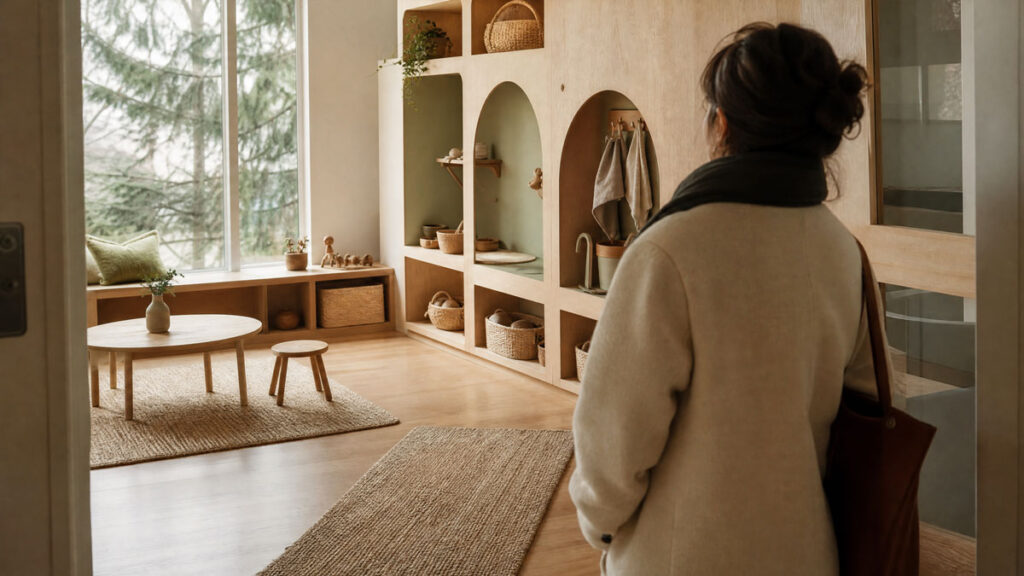
What should you notice at the start of a child care tour?
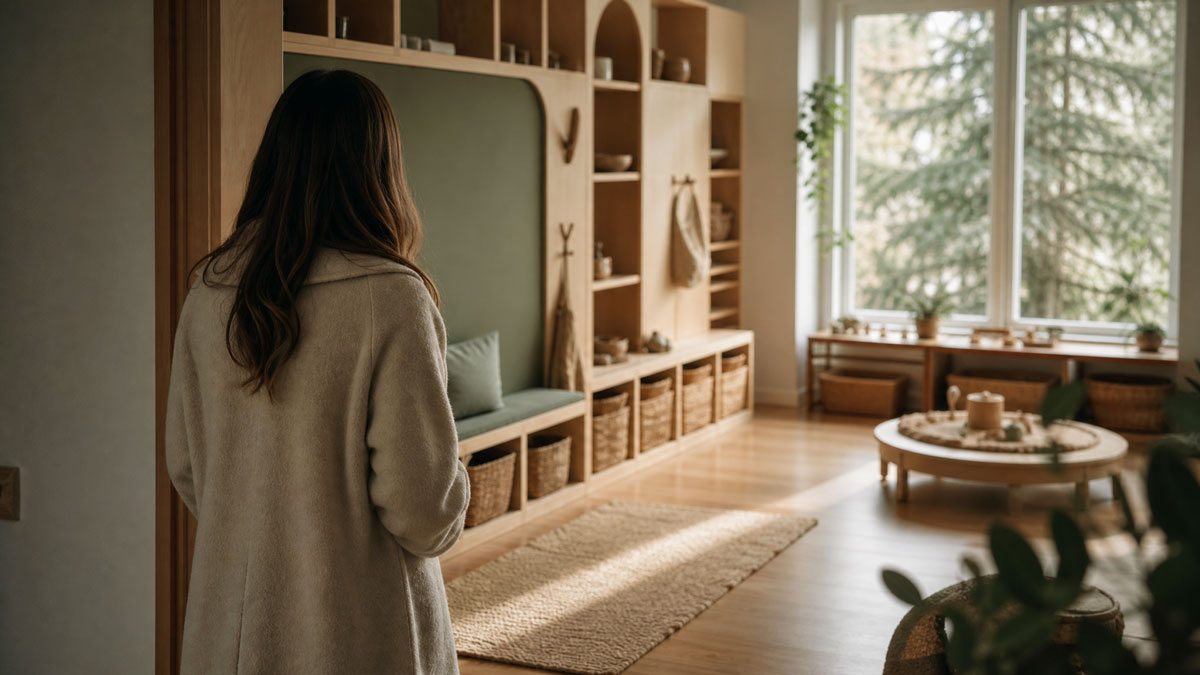
Walk in and pause. Before the tour begins, before anyone explains anything, take thirty seconds and register three things.
The volume. Not whether it is quiet, but whether the noise has a shape to it. Purposeful activity has peaks and troughs: a burst of energy, then settling, then another burst. Constant undifferentiated loudness means a room full of children who are not settled, and children who are not settled are not learning much. This is the most reliable single signal on any tour.
The light. Is it natural, or is it overhead fluorescent? Children spend eight or nine hours a day in these rooms, five days a week, for years. Light quality across that many hours is not a decorative question.
What your own body does. This sounds unscientific and it is the most sensitive instrument you have. If you feel your shoulders drop, that is information. If you feel a low-level urge to leave, that is also information. Your nervous system is reading the room faster than your conscious mind is, and your child’s nervous system is considerably more sensitive than yours.
How are you greeted, and does it matter?
It matters more than almost anything else on the tour, because the way an adult greets a visiting stranger is a fair preview of how the same adult greets a two year old who needs something.
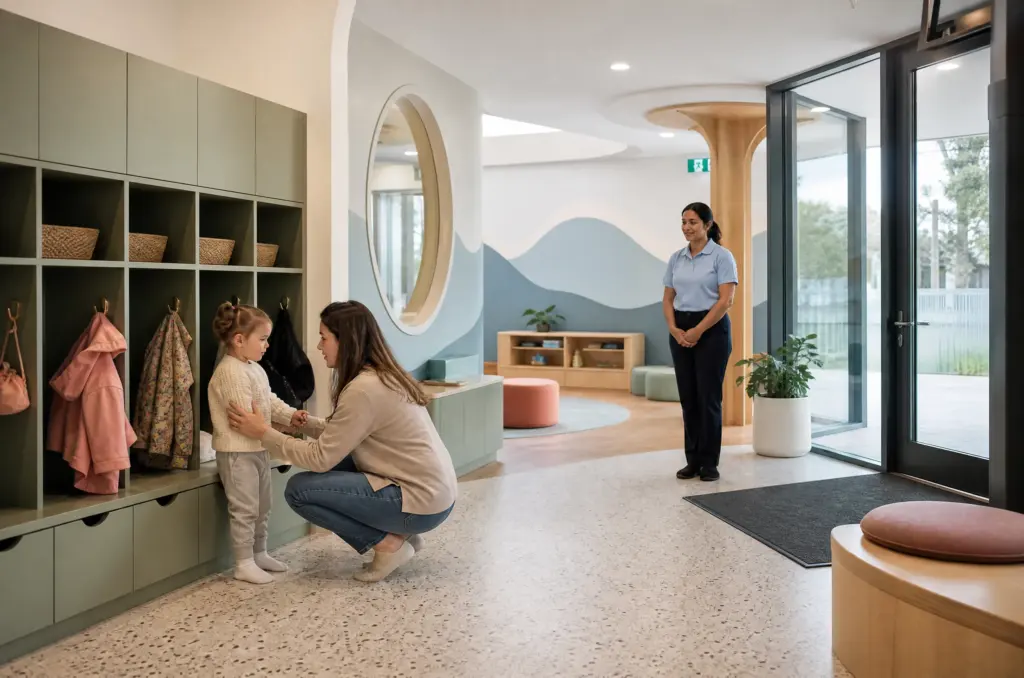
Watch whether an educator who is mid-task stops, makes eye contact, and uses a name. Watch whether the greeting happens at the door or shouted across the room. Watch, if you can, whether a child arriving at the same time as you receives the same quality of attention that you do, or noticeably less. Adults are usually good at performing warmth for other adults. The tell is what happens to the child in the same moment.
At Kinder Roots we hold to something we call the ten foot rule: within ten feet of a family, an educator moves out of task mode and into people mode. Stop, eye contact, use the name. It sounds small. Across a thousand arrivals it is the entire relationship.
What do the materials tell you?
Look at what is actually in children’s hands, not what is displayed on shelves for visitors.
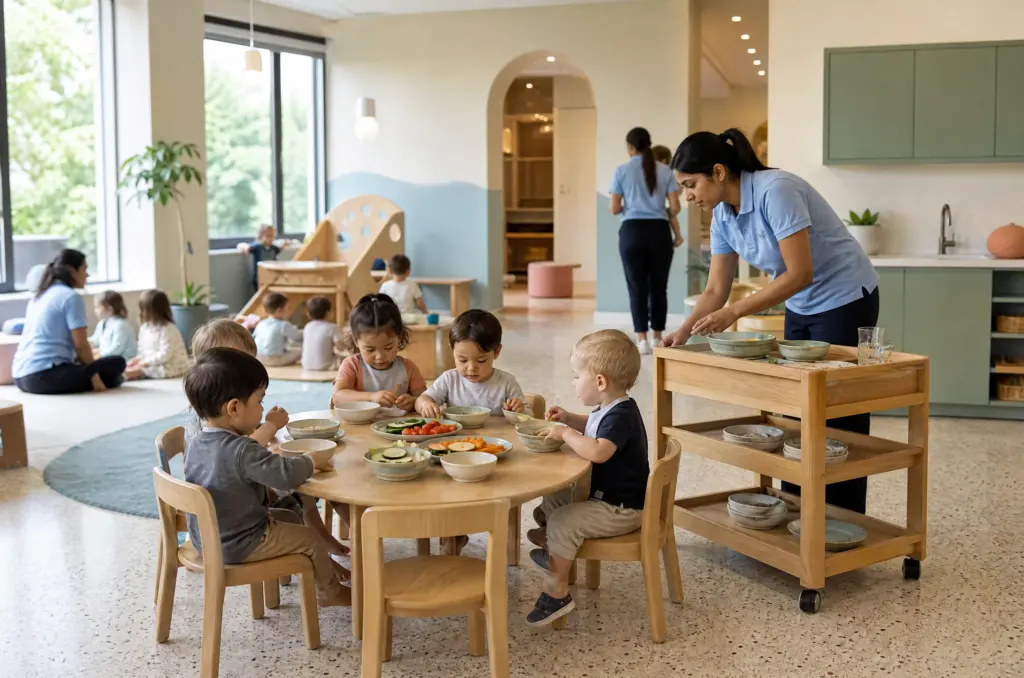
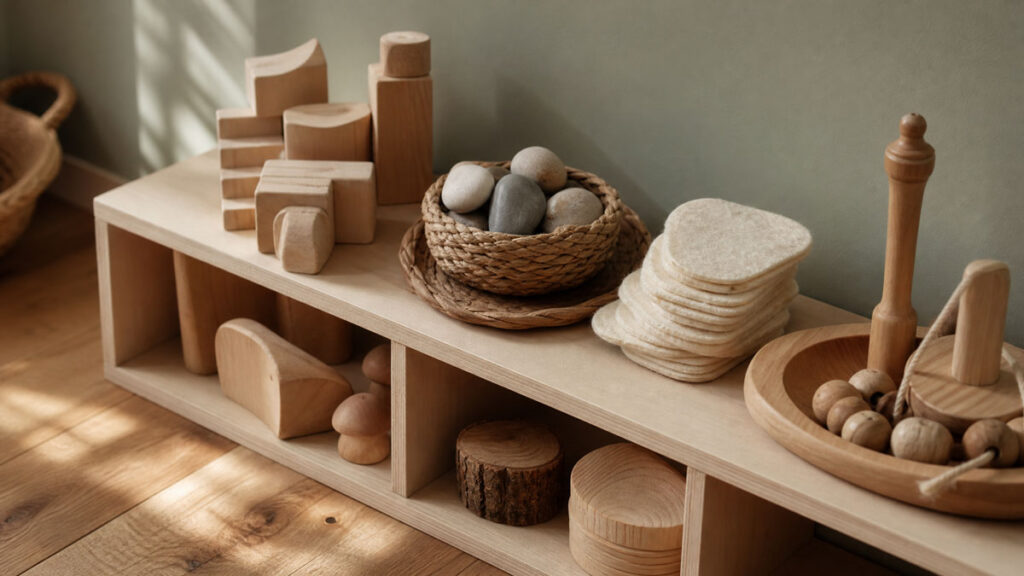
Natural materials, mostly unpainted, in muted tones tend to indicate a program that has thought about sensory load. Wood, wool, seagrass, clay, and real tools sized for small hands are open-ended: a wooden block can be a hundred things across a morning. Bright moulded plastic with a single built-in function tends to be one thing only, and a room full of single-function objects produces a particular kind of shallow, repetitive play that looks busy and teaches little.
Check the height of things. Are materials accessible to children, or stored where only an adult can reach them? A room arranged for adult convenience and a room arranged for child independence look different, and children behave differently in each.
The other tell is what is on the walls. Adult-made commercial decoration everywhere, or children’s actual work displayed at child height? The second indicates a program that treats children as people whose output means something.
What questions actually get honest answers?
Broad questions get brochure answers. Specific ones get real ones. Instead of asking about philosophy, ask about moments.
Walk me through the first ten minutes of the day. Arrival is the highest-stakes moment in a child’s day. A program that has thought carefully will describe it in detail: where a child is met, who meets them, what happens with the coat, what happens if the goodbye is hard. A program that has not will describe a coat hook.
What happens when a child is having a hard time? Listen for whether the answer is about managing behaviour or about helping a child regulate. Those reflect genuinely different beliefs about what a child is and what a difficult moment means, as our guide to emotional regulation in toddlers explains.
How long has the educator in this room been here? Consistency of adults is among the strongest predictors of how secure a child feels. High turnover is not always a program’s fault, and the honest answer to a hard question is itself a good sign.
What would you tell me at pickup on a difficult day? You are testing for honesty. A program that only reports good days is filtering, and you will find out eventually anyway.
How do you handle the goodbye when my child is upset? Watch whether the answer respects the child’s feeling or is mostly about making it disappear quickly for the adult’s comfort.
What do you do if you notice something in a child’s development? Early observation matters enormously in the first five years. Ask whether they use structured developmental screening, how often, and what happens with what they see. Ask whether they have working relationships with speech-language pathologists or occupational therapists.
How do children move between age groups? Transitions inside a program are as significant as the first day, and a thoughtful answer tells you a lot.
What should you ask about the practical things?
The unglamorous questions still need answers, and they are easier to forget when a room is beautiful.
Ask what is included in the fee and what is charged separately, because two programs with identical monthly costs are not comparable if one includes all meals and materials. Our guide to the child care meal program covers what to ask about food. Ask whether they participate in the provincial fee reduction initiative, which affects what you actually pay and which we explain in our guide to BC child care subsidies. Ask about hours and what happens if you are late. Ask about the sick child policy, because you will need it, probably sooner than you expect. Ask how they communicate day to day and how often. Ask what the settling-in period looks like and whether a gradual start is supported. Ask how many children are in the room and how many educators, at the busiest time of day rather than on paper.
What are the quiet warning signs?
A few things are worth noticing precisely because nobody will point them out.
Rooms you are not shown. A tour route that carefully avoids a space is worth a polite question. Children who do not look up when an adult enters, which can indicate that adults entering has stopped meaning anything. Educators who speak about children in front of them as though they were not there. A program that cannot answer a direct question about turnover. And a tour that is entirely a monologue, where nobody asks you anything about your child.
None of these is definitive on its own. Two or three together are worth taking seriously.
How do you weigh it all up afterwards?
Give yourself a day before deciding, and then ask one question: would I be comfortable being a child here for eight hours?
Not whether it looked impressive. Not whether the storage was tidy or the website was good. Whether the pace of the day, the tone of the adults, and the feel of the room would let a small person settle enough to become curious.
Everything a child learns in these years grows out of feeling safe first. Before letters, before numbers, before anything measurable, there is safety, calm, and belonging, and each of those is built by the environment and the people in it rather than taught from a curriculum sheet. A child care tour is your one real chance to see whether a place understands that.
You can read more about how we think about environment on our philosophy page, and see our Redbridge campus in Squamish on the campus page.
Trust what you notice in the first five minutes, ask the specific questions, and give yourself permission to want more than adequate. You are choosing where your child’s foundation gets built, and you are allowed to be particular about it.
Now enrolling in Squamish
Come and ask us the hard questions
Bring the list. Ask about turnover, about ratios at four in the afternoon, about what happens on a difficult day. We would rather answer the specific questions than give you the tour script.
Book a tourRedbridge campus, 1500 Scott Crescent, Squamish. Ages 10 months to 5 years.