



Child care vs nanny is one of the first real decisions families make, and it is usually framed as a cost comparison when it is actually a question about what a particular child needs at a particular age. Both are legitimate. They are good at different things, and the right answer changes as a child grows.
Here is an honest comparison, including where each one is genuinely weaker.

What is the real child care vs nanny trade-off?
Strip away cost for a moment, because cost is genuinely close in many cases and it obscures the actual difference.
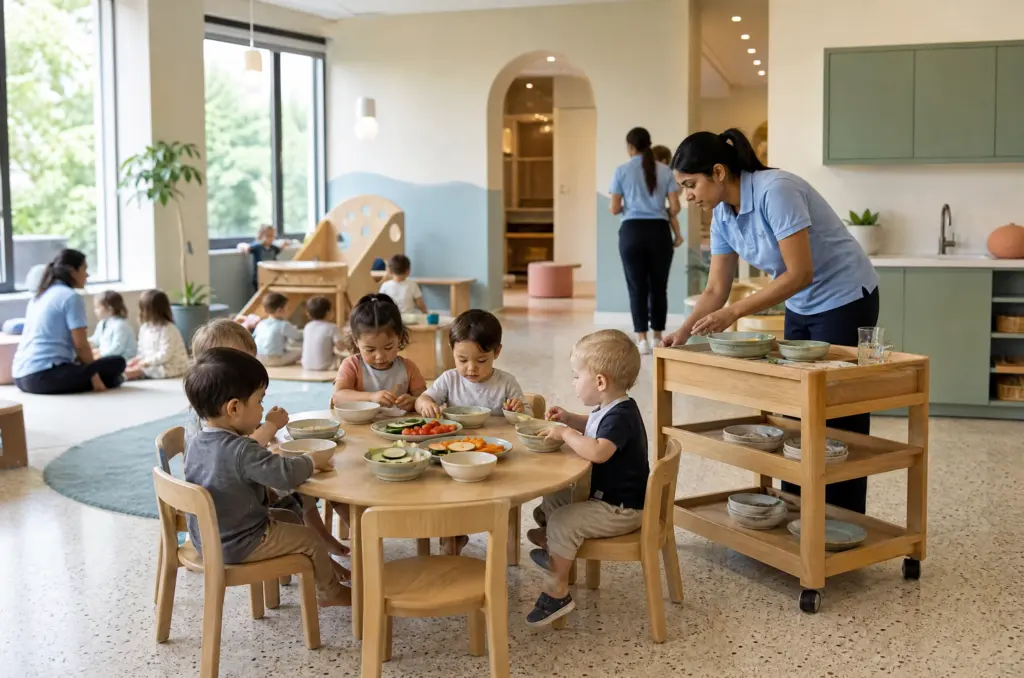
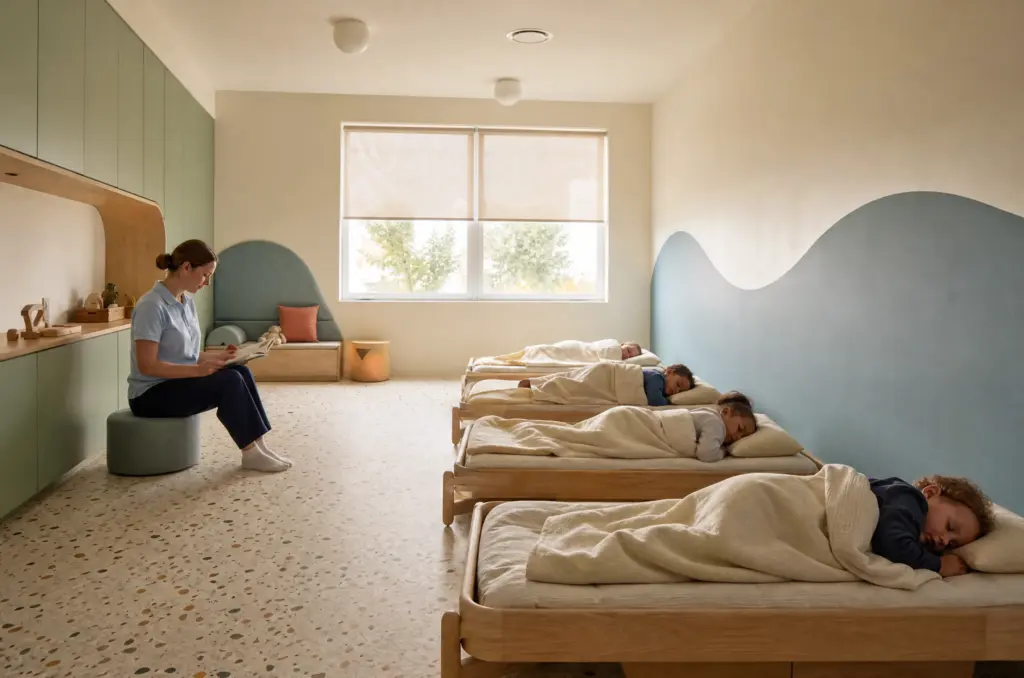
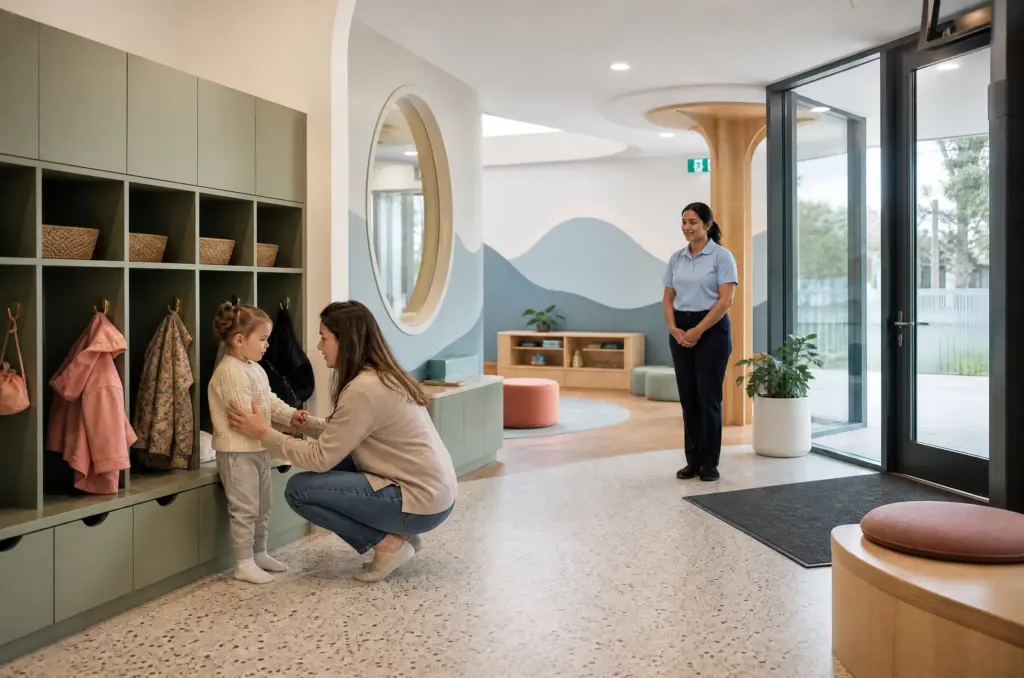
A nanny offers one adult, in your home, on your schedule, giving a child close to undivided attention. A licensed academy offers a group of peers, multiple qualified adults, a designed environment, external oversight, and a program built around developmental stages.
The trade is between individual attention and social environment. Which one matters more depends almost entirely on your child’s age.
When does a nanny make more sense?
Several situations where it is genuinely the stronger option.
Very young infants. Under about a year, the case for a group setting is weakest. What an infant needs most is responsive one-to-one attention from a consistent adult, and a nanny delivers that by definition. Peer socialising is not yet developmentally relevant in any meaningful way.
Irregular or long hours. Shift work, unpredictable schedules, or a day that runs past six will not fit a program that closes at a fixed time.
Multiple young children. The cost comparison shifts sharply with two or three children under five, since a nanny is priced per family rather than per child.
Specific medical or support needs. Some children need a level of individual attention that a group setting cannot practically provide.
No available space. In a market with a documented shortage, this is the reason many families actually choose a nanny. It is a legitimate one.
Fewer illnesses. A child in a home with one carer gets sick far less than a child in a group room, particularly in the first year. This is a real quality-of-life difference for working parents.
When does a group program make more sense?
The balance shifts considerably as children get older.
From roughly eighteen months onward. Peer interaction stops being incidental and starts being the developmental work itself. Negotiating over a toy, waiting a turn, reading another child’s face, recovering from a small conflict. These require other children, repeatedly, and they cannot be simulated by an attentive adult.
Three to five particularly. Collaboration, extended group projects, and the social capacities that carry into kindergarten all get built here. Our guide to the preschool years in Squamish covers what this age band is actually for, and it is overwhelmingly social.
When you want oversight. A licensed program is inspected, has enforceable ratios, criminal record checks, and a complaints mechanism. A nanny arrangement has whatever verification you personally did. Our guide to licensed child care in BC covers what that oversight actually includes.
When continuity matters. A nanny leaving is a total loss of care with no backup, often at short notice. A program absorbs staff changes without your arrangement collapsing.
When you want structured observation. Programs that use developmental screening see your child alongside dozens of others of the same age, which is a genuinely different vantage point. Our guide to developmental screening in early childhood explains why that matters in these years.
Subsidy eligibility. Only licensed programs participate in the provincial fee reduction initiative, which substantially changes the real monthly cost. See our guide to BC child care subsidies.

What about the cost?
The comparison is closer than most people expect, and it moves in both directions.
A nanny is an employment relationship. That means a wage at or above provincial minimum, statutory holiday pay, vacation pay, CPP and EI contributions, and payroll administration. Many families budget only for the hourly rate and are surprised by the full employer cost.
A licensed program has a published monthly fee, but the figure you actually pay is reduced by the provincial fee reduction initiative, which applies automatically at participating programs. The income-tested Affordable Child Care Benefit can reduce it further. Neither applies to a private nanny arrangement.
For one child, a licensed program is usually less expensive once subsidies are counted. For two or three children under five, a nanny often becomes competitive or cheaper. Run your own numbers with the subsidies included rather than comparing headline figures, because the headline comparison is misleading in both directions.
What about a nanny share?
Worth mentioning because it sits usefully between the two.
Two families employ one nanny, splitting the cost and giving each child one peer. It reduces cost meaningfully, adds a little social contact, and keeps the home setting and flexible hours.
The complication is that it is a shared employment arrangement between two households, which means agreement on schedules, sick days, holidays, discipline approach, and what happens when one family’s circumstances change. Nanny shares fail more often over the relationship between the families than over anything to do with the nanny. Put it in writing.
What should you ask either way?
For a nanny: current criminal record check, first aid certification, references from at least two previous families that you actually call, what happens when they are ill, and how they would handle a specific difficult moment such as a full meltdown.
For a program: how long the educators in the room have been there, what the ratio looks like at the busiest point of the day, what happens when a child is having a hard time, and what you would be told at pickup on a difficult day. Our guide to what to look for on a child care tour covers this in full.
For both: what does an ordinary Tuesday look like, start to finish.
Does it have to be one or the other?
No, and many families do not treat it as permanent.
A common pattern in British Columbia is a nanny or family care through the first year or so, then a move into a licensed program somewhere between eighteen months and three years, when peer interaction becomes the thing the child most needs. That sequence matches the developmental arc well.
The practical catch is that you have to join waitlists during the nanny period, not at the end of it. Waits at these ages are long, and a family who waits until their child is two to start looking is typically eighteen months behind. Our guide to child care waitlists in Squamish covers the timing.
Where we sit
Our programs start at ten months and run to five years, which spans the period where most families make this transition. You can see how the age bands are structured on our programs page and read about the environment on our campus page.
The child care vs nanny question has no universal answer, and anyone who gives you one is selling something. Individual attention matters most when children are very young. Social environment matters most from the toddler years onward. Work out where your child sits on that arc, price both options with subsidies included, and keep your options open by joining lists early either way.
Now enrolling in Squamish
When the group becomes the point
Our programs span 10 months to five years, which covers the period where most families move from one-to-one care into a group setting. Joining a list early keeps that option open.
Redbridge campus, 1500 Scott Crescent, Squamish. Ages 10 months to 5 years.
Reviewed by the Kinder Roots Education Team