



Infant care Squamish families can actually get into is the hardest child care to find here, and the reason is structural rather than accidental. Under-three care requires far more educators per child than any other age group, which makes it the most expensive kind of space to operate and the least common kind to find. If you are returning to work before your child turns three, you are searching in the tightest part of an already tight market.
That is the difficult part. The useful part is that understanding how this age band actually works changes how you search, what you ask on a visit, and what you should reasonably expect. This guide covers all three.

Why is infant care Squamish parents need so hard to find?
Three constraints stack on top of each other, and none of them is going to change quickly.
Ratios. British Columbia’s licensing rules require substantially more qualified educators per child for infants and toddlers than for three to five year olds, as we explain in our guide to child care ratios in BC. This is the correct rule. A ten month old cannot wait, cannot explain what they need, and cannot regulate themselves through distress. They need an adult who is actually available. But the consequence is that the same square footage and the same staffing budget produce a fraction of the spaces they would produce for older children.
Educator qualifications. Infant and toddler care requires additional specialist certification beyond the base early childhood education credential. That pool is smaller than the general ECE pool, and every program in the Sea to Sky corridor recruits from it. A program can have a licensed, built, ready room and still not open it, because it cannot staff it. When you hear that a program has capacity it is not using, this is usually why.
Turnover timing. Preschool rooms empty predictably every September as children leave for kindergarten. Infant rooms have no equivalent. A space opens when one specific child moves up an age band, on that child’s schedule and nobody else’s. There is no season, no window, no rhythm you can plan around.
Together these explain why local referral services report the longest waits in this band, and why some Squamish programs will not accept a waitlist submission until a child is actually born. We have written more on how local lists work in our guide to child care waitlists in Squamish.
When should you start looking?
Earlier than feels reasonable. For infant care Squamish waitlists in particular, families are commonly advised to join twelve to eighteen months before they need the space, which for many parents means during pregnancy or in the first weeks after birth.
A workable timeline for a parent planning to return at the end of a twelve or eighteen month leave:
During pregnancy. Identify which programs accept prenatal registration and which require a birth date. Prepare the applications you will not have the energy to research later.
Within weeks of birth. Join every list that requires a date of birth. This is the moment that matters most and the one most easily lost to the fog of a newborn.
Six months out from your return. Confirm your details are current with every program and restate your required start date. Ask whether anything has changed about their intake.
Three months out. Contact the Sea to Sky Child Care Resource and Referral coordinator, who holds a view of the whole local landscape including programs you may not have found.
Throughout. Watch for new capacity opening rather than only waiting for turnover. A new campus adds spaces all at once.
What should you actually look for in an infant room?
Here the search changes character entirely. For a three year old you might reasonably ask about activities, projects, and what the day teaches. For a ten month old, almost everything that matters is about the environment and the adults inside it, because that is what a baby is actually learning from.
The sound of the room. Stand in the doorway and listen before you look at anything. A well-run infant room is not silent, but it is not loud either. It has a shape to it: activity, then settling, then activity. Constant high undifferentiated noise is a room that is dysregulating the children in it, and unlike an adult, a baby cannot step outside for a minute.
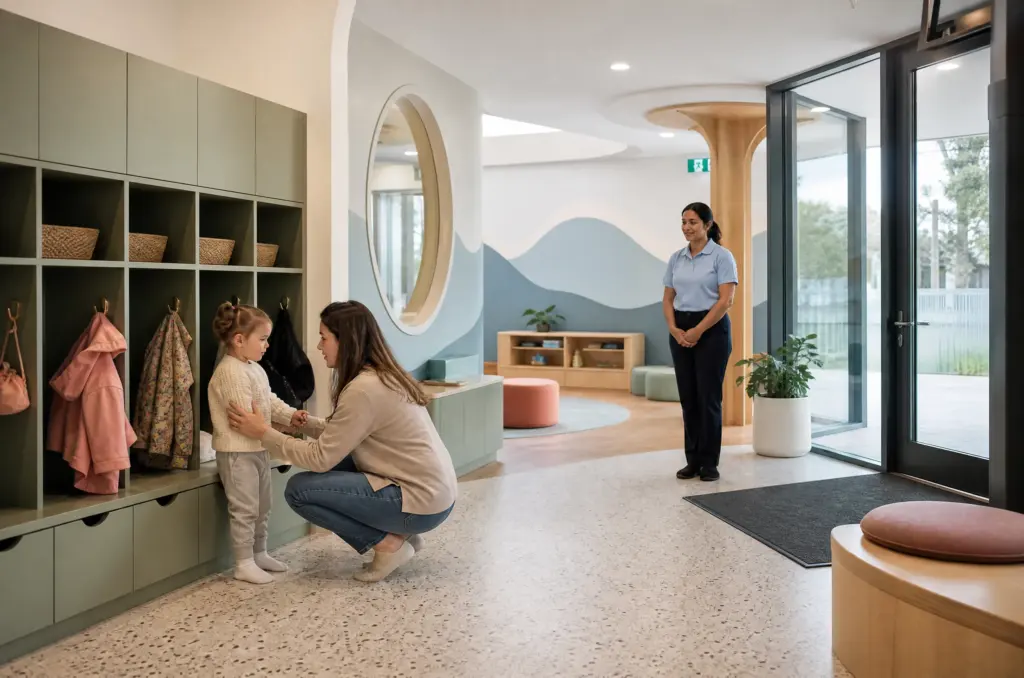
Who greets you, and how. Watch what happens when someone enters. Does an educator stop what they are doing, make eye contact, and use a name? That small moment is a fair preview of how the same adult responds to a child who needs something. At Kinder Roots we hold to what we call the ten foot rule: within ten feet of a family, an educator moves out of task mode and into people mode.
Consistency of faces. Infants build security through repetition with specific people. A baby who sees six different adults in a week is doing six times the work of learning who is safe. Ask how many educators a child typically sees, whether the same person handles arrival and departure, and what staff turnover has looked like over the past year. Ask it plainly. A good program will answer plainly.
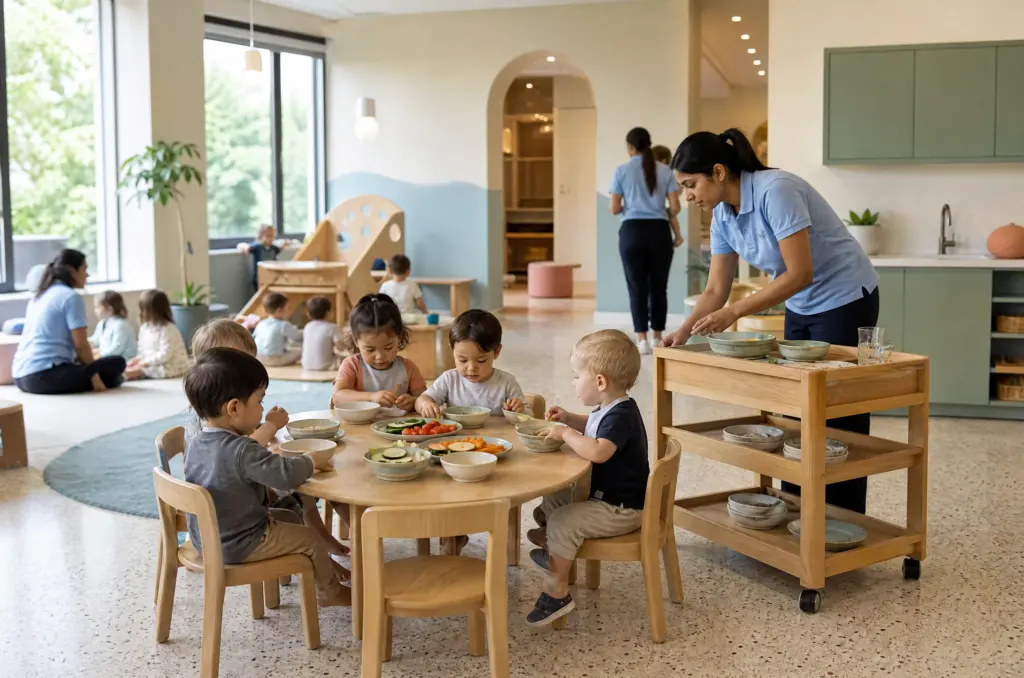
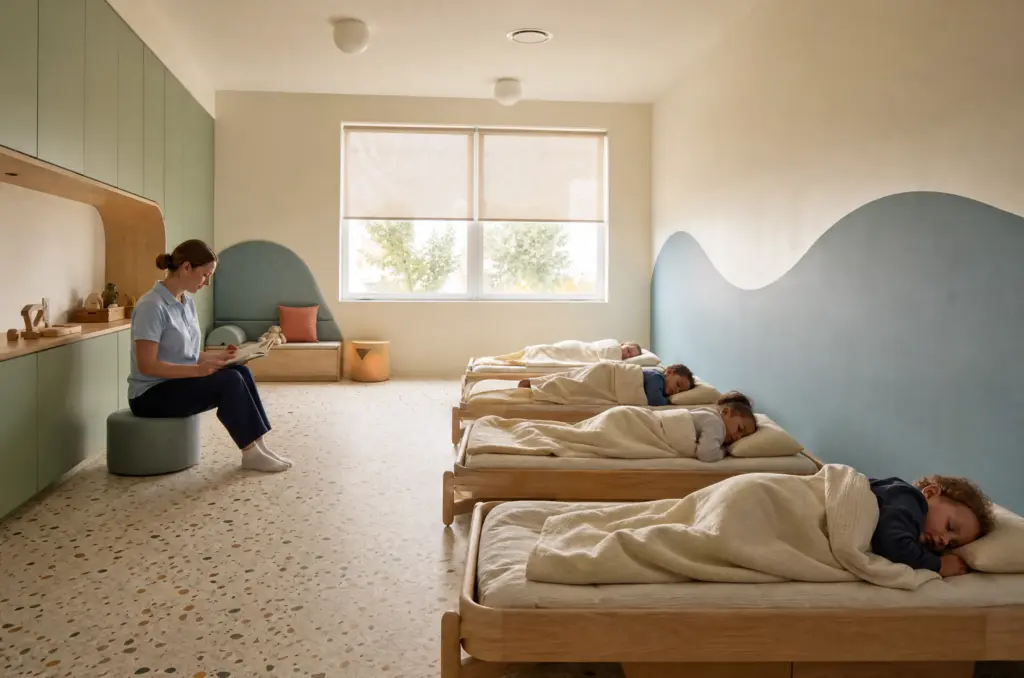
What the room is made of. Natural materials, muted colours, and uncluttered surfaces are not a design preference. In the first years a child’s nervous system is still being built, and the room is one of the inputs. Bright, cluttered, visually loud spaces ask a baby to filter constantly, and filtering is expensive. Calm spaces let a child settle first and then explore outward from that settled place. This is the single thing we would most want a parent to notice.
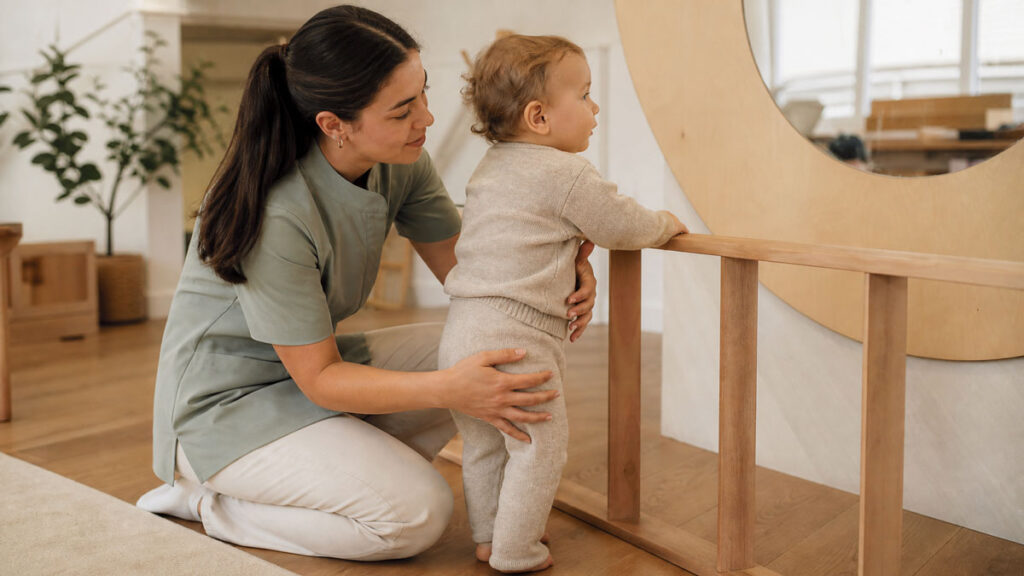
Floor time and freedom to move. Look at whether babies are on the floor with room to move, or contained in equipment for long stretches. Physical exploration is how an infant learns where their body ends and the world begins.
How handovers are handled. Ask what happens in the first ten minutes of the day and the last ten. Those two transitions carry more emotional weight for an infant than everything in between, and a program that has thought carefully will describe them in real detail.
What questions get honest answers?
Broad questions produce brochure answers. These tend to produce real ones.
What happens when a baby cries and two others need something at the same time? How long has the educator in this room been here? What does a hard day look like, and how would I hear about it? How do you decide when a child is ready to move up an age group? How do you handle feeding, and what happens if my child refuses a bottle? What does the settling-in period look like, a subject we cover in our guide to the first few weeks of child care? What is your approach to sleep, and what if my child’s rhythm at home is different?
And one more that matters more than it sounds: what do you do if you notice something in a child’s development that concerns you?
The window in which early support makes the largest difference is short. A program that observes carefully and says something early is offering something genuinely valuable, and a program that avoids the conversation to keep things comfortable is not. Ask whether they use any structured developmental screening, how often, and what actually happens with what they find. Ask whether they have relationships with speech-language pathologists or occupational therapists, because knowing who to call is half of that work.
How do you cope with the search itself?
It is worth saying plainly that this process is stressful, and that the stress is a reasonable response to a real constraint rather than a sign you are doing it wrong.
A few things help. Apply broadly, because breadth costs you nothing and every provider expects it. Decide your non-negotiables in advance so that a two-day decision window does not become a crisis. Keep a simple list of where you have applied and when, because after the eighth application they blur together. And accept that you may need an interim arrangement, which is not a failure of planning but a normal feature of a market with a documented shortage.
What does this mean for the year ahead?
Squamish is adding infant capacity, which has not been true for a while. Kinder Roots opens its Redbridge campus in Fall 2026 with an Infant Toddler program for children 10 to 17 months, alongside JK1 for 18 to 30 months and JK2 for 3 to 5 years. Because this is a new campus, those spaces open together rather than one at a time as individual children age out. You can see how the age bands work on our programs page.
Searching for infant care in a tight market is genuinely hard, and it is reasonable to find it wearing. But the families who start early, ask direct questions, and stay on several lists do find care. Start before you think you need to, ask the questions that get real answers, and trust what you notice when you walk into a room.
Now enrolling in Squamish
New infant spaces in Squamish
Infant spaces are the hardest to find here, because they open only when one child moves up. Our Infant Toddler program for 10 to 17 months opens with the campus, so the spaces are not waiting on turnover.
Join the waitlistRedbridge campus, 1500 Scott Crescent, Squamish. Ages 10 months to 5 years.