



Knowing when to keep your child home is one of the recurring difficulties of group care, and it rarely feels clear at seven in the morning with a slightly warm toddler and a meeting at nine. Licensed programs in British Columbia work from written illness policies and public health guidance, and most of what seems like a judgement call is already covered. Knowing the rules in advance removes most of the guesswork.
Here is how illness is handled in BC licensed care, what typically sends a child home, and what to ask before you enrol.
Who decides when to keep your child home?
Every licensed facility in BC is required to have a written health and illness policy, and licensing expects it to be followed. In the Sea to Sky corridor, the health authority is Vancouver Coastal Health, and facilities work from its guidance, including the Quick Guide to Common Childhood Diseases, which sets out exclusion periods for specific illnesses.
That means two things for you. First, there is a document, and you are entitled to read it before you enrol. Second, the answers are not arbitrary. When a program sends a child home, it is usually applying a policy rather than making a call.
Ask for the illness policy during your tour rather than after your first sick day. Our guide to what licensing in BC actually guarantees covers what else sits behind a licence.
What usually sends a child home?
Policies vary in their detail, so treat this as the general shape rather than a specific facility’s rule. Confirm the thresholds with your own program.
Fever. Most policies use a threshold around 38 degrees Celsius, and most require a child to be fever free for a full twenty-four hours without fever-reducing medication before returning. The medication clause is the part families miss. A dose of acetaminophen at seven in the morning does not make a child well, it makes a child briefly comfortable, and the fever usually returns by mid-morning.
Vomiting and diarrhea. This is the strictest category, and reasonably so, since gastrointestinal illness moves through a room of toddlers faster than anything else. Vancouver Coastal Health’s outbreak policy for licensed daycare directs that children and staff stay away for at least forty-eight hours after the last symptom. Many facilities apply the forty-eight hour rule routinely rather than only during a declared outbreak. Food handlers face a longer exclusion.
Anything requiring more care than the room can give. This is the catch-all and it is the most practical of the criteria. A child who cannot take part in the day, who needs to be held continuously, or who needs one adult’s sustained attention cannot be cared for in a room with a ratio. That is not a severity judgement. It is arithmetic.
Specific communicable illnesses. Conditions such as chickenpox, measles, pertussis, hand foot and mouth disease, and conjunctivitis carry their own exclusion periods in the public health guidance, and some require clearance before return. During an outbreak of a vaccine-preventable illness, children who are not immunized against it may be excluded until the health authority approves their return.
Undiagnosed rash. Usually excluded until a cause is established, because a rash can be several things and some of them are contagious.
What does not usually require staying home?
This matters as much as the other list, because a strict reading of symptoms would keep a toddler home for most of the winter.
A runny nose with no fever is not an exclusion. Children in group care get a great deal of colds, particularly in the first year, and a clear or even coloured nose on an otherwise well child is ordinary. A lingering cough after an illness has resolved is also generally fine. Once temperature, energy, and general wellbeing are back to normal, a cough and a runny nose can continue for a week or two without the child being infectious.
Teething does not cause a true fever. A warm, miserable, teething child who is over the threshold has something else going on.
The question that cuts through most of it: can this child take part in the day. A child who is eating, drinking, playing, and holding their usual energy is well enough to be there. A child who is lying on the floor is not, regardless of what the thermometer says.
Why are the rules this strict?
Because the alternative has been tried. A room of ten toddlers shares everything, and the mathematics of transmission in that setting is unforgiving. One child with norovirus who returns a day early can produce a two-week outbreak that closes a room, affects thirty families, and takes several educators out at once.
The forty-eight hour rule looks excessive on day two when your child seems recovered. It exists because people remain infectious after symptoms stop, and a program that enforces it is protecting your child in the weeks when someone else’s child is the one who is ill.
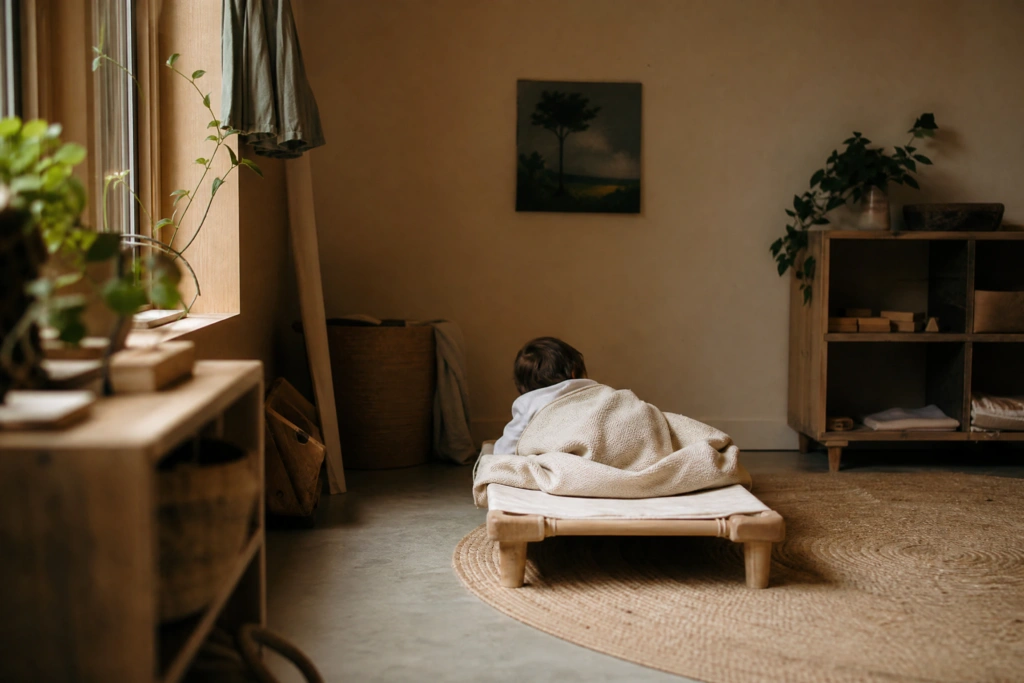
There is a second reason, and it is about the child rather than the room. A child who is recovering needs sleep, quiet, and one familiar adult. A busy room with a ratio of one to four cannot supply any of those. Sending a child home is often the better care rather than the inconvenient one.
What should you ask before you enrol?
A short list that prevents most of the friction later.
What is the fever threshold, and is the twenty-four hour clock measured without medication. What is the rule after vomiting or diarrhea, and does it apply all the time or only during outbreaks. Who makes the decision to send a child home, and how quickly am I expected to arrive. Where is a sick child cared for while they wait, and is someone with them. Do you administer medication, and what paperwork does that need. Do you require a doctor’s note to return, and for what. How are families notified when something is going around. Do I pay for days my child is excluded.
That last one is worth asking plainly. Most programs charge for the space rather than for attendance, which is standard, and knowing it in advance is better than discovering it.
How do you plan for the first winter?
The honest expectation: a child entering group care for the first time gets ill more often for the first six to twelve months, and the first winter is the heaviest of it. This is immune development rather than a failure of hygiene, and the frequency drops considerably after the first year.
Plan for it rather than being surprised by it. Work out your backup care before you need it, since the day you need it you will have about an hour. Identify who in your household can be called away, and alternate rather than defaulting to one parent. Keep a thermometer and a plan. If you are returning to work around the same time, our timeline for returning to work in BC covers the sequencing.
Where the policy is pointed
An illness policy can read as a list of restrictions, and from the doorway on a Tuesday morning that is how it feels. It is better understood as the agreement that lets a room full of young children be together safely at all. The program that holds the line on the forty-eight hours is the same program that keeps your child’s room open in February. Read the policy early, ask the specific questions, and the sick days become logistics rather than conflict.
Now enrolling in Squamish
The policies written down before you need them
Our illness policy, ratios, and health practice are set out in advance, so a Tuesday morning decision is a matter of reading rather than negotiating. Ask for all of it on your tour.
Join the waitlistRedbridge campus, 1500 Scott Crescent, Squamish. Ages 10 months to 5 years.
Reviewed by the Kinder Roots Education Team