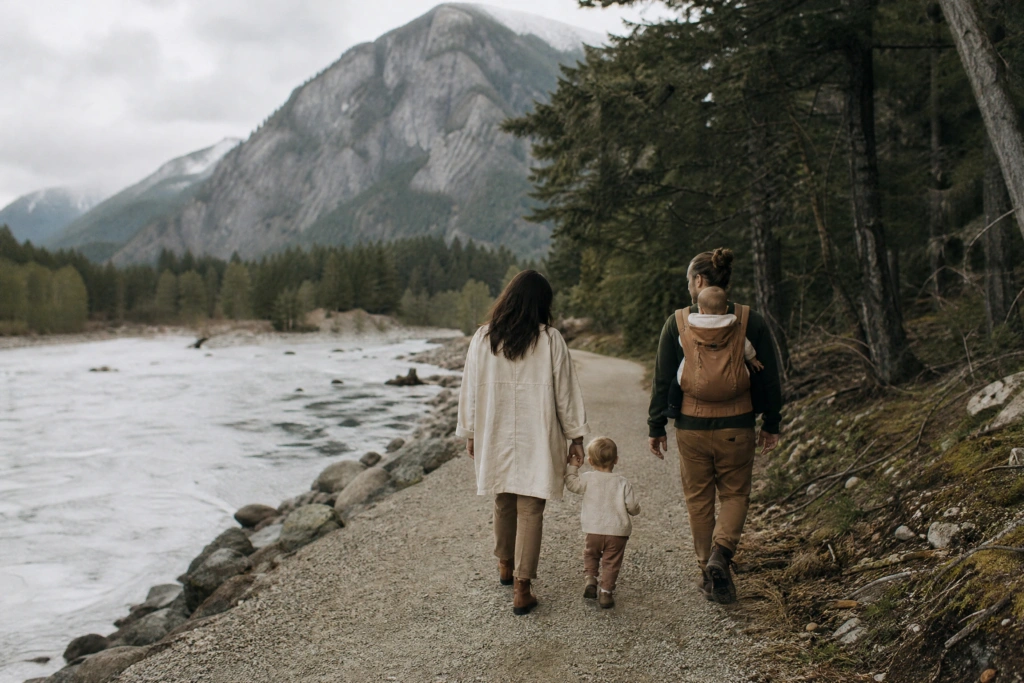


Every November, Squamish parents ask the same question in some form: is my child really going outside in that? The answer at any well-run program is yes, and the reason is not stoicism. Outdoor play in winter is not an endurance test. Children in this part of British Columbia who only go out on dry days lose most of the winter. What makes that workable is not toughness. It is gear, and a program that treats wet weather as ordinary rather than exceptional.
Here is what actually keeps a child warm, dry, and willing, and what to ask about how a program handles the wet months.
Why does outdoor play in winter matter enough to bother?
The case for being outside does not weaken when the temperature drops. If anything it sharpens, because the alternative is six months of indoor air, indoor noise, and indoor bodies.
Outdoor time regulates. A child who has been outside has had space to move at full volume, pressure through the joints from climbing and carrying, and a visual field that extends past four walls. All of that settles a nervous system in a way that no indoor activity reliably matches. The child who comes in from an hour outside is a different child from the one who has been inside all morning, and every educator who has worked a rained-out day knows it.
Winter also offers things no other season does. Puddles behave differently when the edges are frozen. Rain on a cedar sounds nothing like rain on a roof. Mud has a dozen consistencies between October and March, and a child who has handled all of them has learned something about materials that a sunny afternoon cannot teach.
Our longer piece on why outdoor play does the real work covers the developmental side in more depth.
What does a child actually need to stay out in Squamish rain?
Squamish winter is wet rather than bitter. November through February is the heavy stretch, and most of what falls is rain rather than snow. That matters, because dressing for wet cold is a different problem from dressing for dry cold. Wet cold gets through anything that is merely thick.
The system that works has three parts, in this order.
A base layer that is not cotton. This is the part most families skip and it is the part that decides the outcome. Cotton absorbs sweat and then holds it against the skin, which is how a child ends up cold while wearing a great deal of clothing. Merino wool or a synthetic base layer moves moisture away instead. One good set, worn under everything, changes the whole day.
A warm middle layer. Fleece or wool, loose enough to trap air. Two thin layers beat one thick one, because the air between them does the insulating and because a child who warms up from running can shed one.
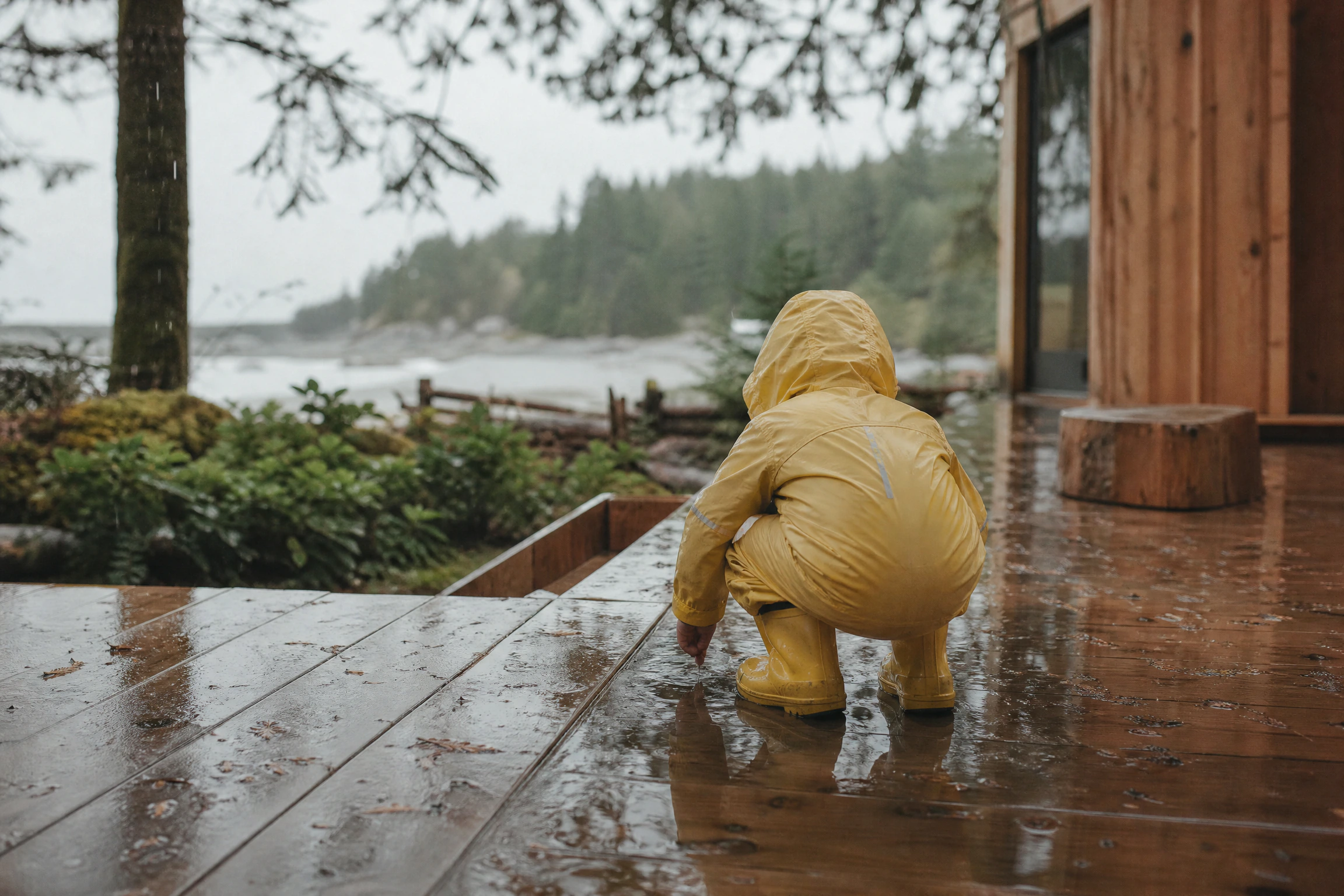
A genuinely waterproof outer layer. Not water resistant. A full rain suit, jacket and trousers, with sealed seams and a hood that stays up. Puddle suits exist for exactly this and they are the single highest-value purchase for a Squamish winter. Water resistant softshells look like outerwear and fail within twenty minutes of real rain.
Then the parts that decide whether a child asks to go back in: rubber boots with wool socks, sized up enough that a thick sock fits without compressing, because a tight boot is a cold boot. Waterproof mittens rather than gloves, since fingers warm each other, and mittens that attach to the sleeve so they stay attached. A hat under the hood. A spare of everything.
What should a program provide, and what should you send?
Ask this directly, because practice varies and the difference shows up in whether your child is actually outside.
Some programs hold a stock of spare rain suits and boots in common sizes. Some expect every item to come from home and will keep a child in if the gear is not there. Neither is wrong, but you need to know which one you are dealing with before the first wet week.
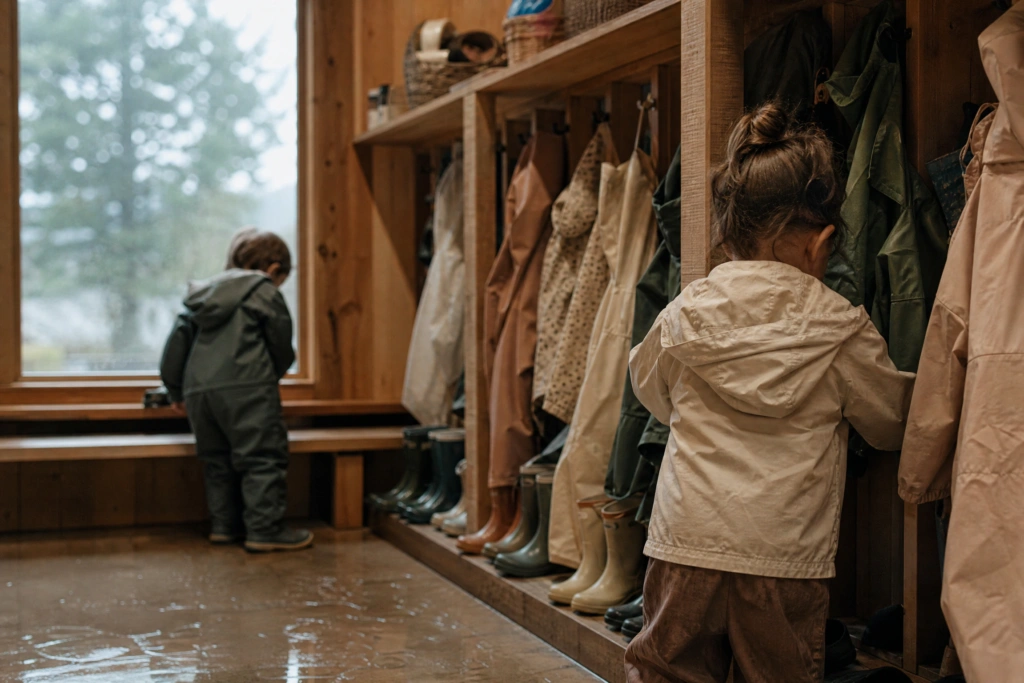
The questions worth asking: what does a child need to have here in order to go out, do you keep spares, where does wet gear dry between sessions, and what happens on a day when a child arrives without rain trousers. A program with a drying room or a heated gear rack has thought about winter properly. A program with a pile of damp coats on a hook has not, and the consequence is that the gear is still wet at two in the afternoon.
Also ask what weather actually cancels outdoor time. A reasonable answer names specific conditions: lightning, high wind with trees overhead, extreme cold, air quality. An answer that amounts to heavy rain tells you the winter will largely be indoors.
How do you get a reluctant child out the door?
Resistance to going out is usually not about the weather. It is about the fifteen minutes of dressing that precede it, which for a two year old is a long and effortful negotiation in a hallway.
A few things reliably help. Dress in a warm room rather than by the cold door, so the process is not itself unpleasant. Let the child do the parts they can, even slowly, because a child who put their own boots on is more invested in using them. Keep a consistent order so the sequence becomes automatic rather than a fresh event each time. And stop narrating the weather as a problem. A child who hears that it is miserable out there has been told what to think before they have had a chance to decide.
The other half is comfort. Almost every child who objects to being outside in winter is objecting to being cold or wet, and almost every instance of that traces back to cotton against the skin or water in a boot. Fix the gear and the resistance usually goes with it.
What does wet-weather practice look like in a well-designed program?
The physical setup tells you most of it. Covered outdoor space means the day does not stop when the rain starts. Somewhere to store and dry thirty sets of gear means the gear is usable tomorrow. A transition area between outside and inside means mud stays where it belongs and nobody treats going out as a disruption.
Rooted in Nature is one of the four pillars the Kinder Approach is built on, and in a coastal climate that commitment is tested in January rather than July. Designing for the wet months is what makes outdoor time a rhythm rather than a seasonal treat.
You can see more of how the environment shapes the day in our guide to what to look for on a tour.
A short gear list to work from
For a Squamish winter, per child: two merino or synthetic base layer sets, two fleece or wool mid layers, one waterproof rain suit with sealed seams, one insulated winter coat and snow trousers for the colder dry days, rubber boots one size up, insulated winter boots, four pairs of wool socks, two pairs of waterproof mittens, two hats, and a labelled bag to carry the wet things home in.
Label everything. In a room of eighteen children, unlabelled mittens belong to nobody by the second week.
The season is not an obstacle
A child who spends a Squamish winter outside comes out of it having handled weather rather than waited it out. They know what the forest does in the rain, how to move on ground that gives, how their own body warms up once it starts working. That is not endurance. It is competence, and it is built in exactly the months most families assume are a write-off. Dress for it properly and the whole year opens up.
Now enrolling in Squamish
Built for the months most families write off
Rooted in Nature is one of the four pillars the Kinder Approach is built on, and in a coastal climate that is tested in January. Our Redbridge campus in Squamish was designed with substantial outdoor space and somewhere to dry thirty sets of gear, so the wet months stay part of the rhythm.
Join the waitlistRedbridge campus, 1500 Scott Crescent, Squamish. Ages 10 months to 5 years.
Reviewed by the Kinder Roots Education Team