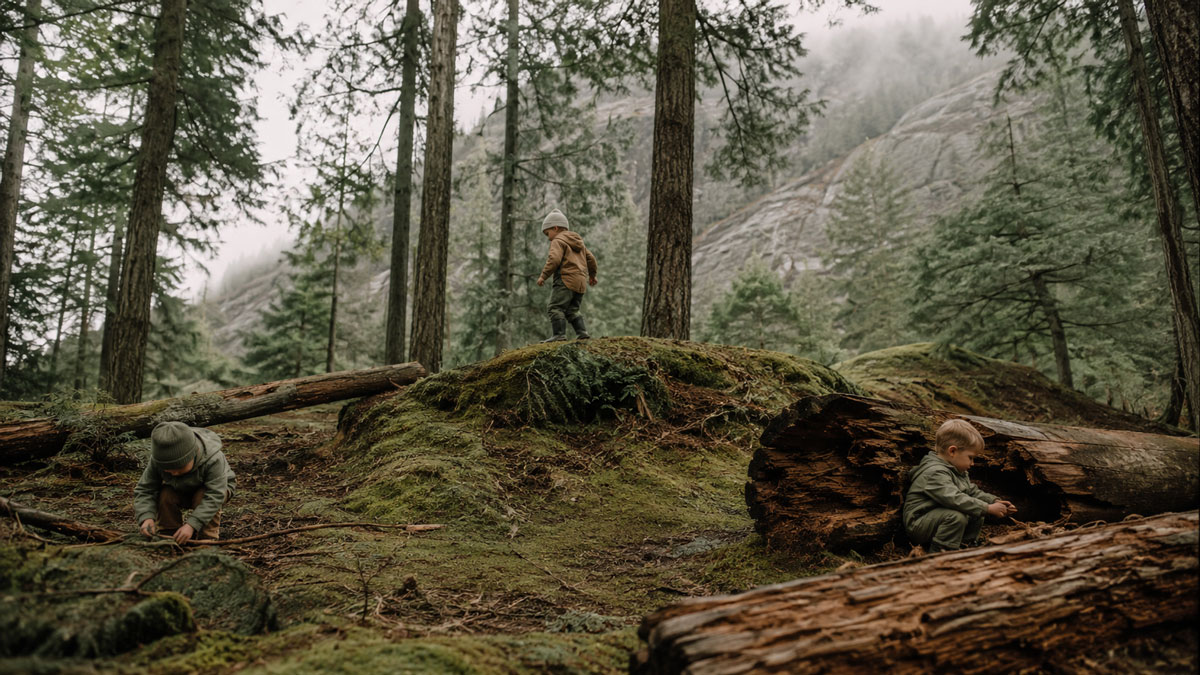

Outdoor play early childhood programs build into the day is not a break from learning. It is where a large share of the learning happens, and in the first five years it does work that no indoor activity replicates: physical literacy, risk assessment, sensory regulation, and the beginnings of a relationship with the natural world.
In a place like Squamish, surrounded by forest, river, and mountain, the question is not whether children should be outside. It is what a program does with the weather when it turns, which it does for much of the year.
What does outdoor play early childhood development actually build?
Four things, none of which have good indoor substitutes.
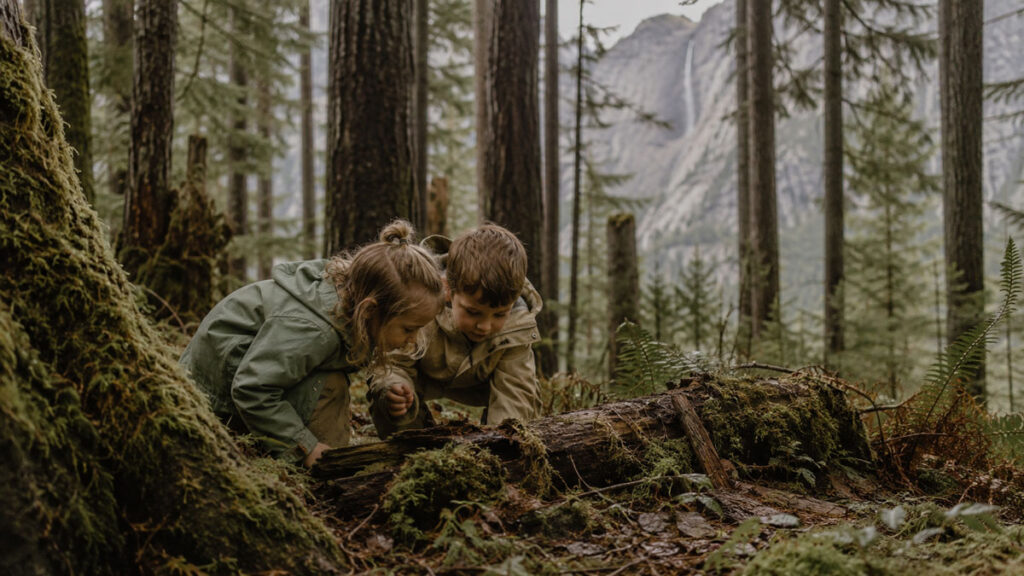
Physical literacy. Climbing, balancing, jumping from a height, carrying something heavy, running on uneven ground. These build core strength, balance, and body awareness, and they are the physical foundation that later skills including handwriting sit on. A child who has never climbed has less developed spatial awareness than one who has, and it shows in unexpected places.
Risk assessment. This is the one adults find hardest and it matters enormously. A child who is allowed to climb slightly higher than is entirely comfortable is learning to evaluate their own capability. Children who are never permitted to take a manageable risk do not become safer children. They become children with no practice at judging risk, which is considerably more dangerous later.
Sensory regulation. Natural environments regulate. The irregular sounds, varied light, uneven ground, and open space all ask less of a nervous system than a bright, echoing, visually busy indoor room. Many children who struggle indoors are noticeably calmer outside, and the reason is sensory rather than behavioural. We cover the underlying idea in our guide to emotional regulation in toddlers.
Open-ended thinking. A stick is a hundred things. So is a puddle, a pile of leaves, a slope. Natural materials have no built-in function, which means the child supplies it, which is exactly the cognitive work worth doing.
How much outdoor time is enough?
More than most programs manage, and the honest answer is that it depends on what the time contains.
A useful benchmark is that outdoor time should be a substantial daily block rather than a short scheduled release, and it should happen in most weather rather than only in good weather. Twenty minutes on a fenced patch of grass is not the same as ninety minutes with room to run, things to climb, and materials to manipulate.
Ask any program you visit three questions. How long are children outside on a typical day. What happens on a wet day, and be specific. What is actually in the outdoor space beyond fixed play equipment.
That last one matters. A yard with a single plastic climbing structure and rubber matting offers far less than a yard with varied ground, natural materials, loose parts, things to dig in, and something growing.
What about the weather in Squamish?
This is the practical crux, because the Sea to Sky corridor gets a great deal of rain and a real winter.
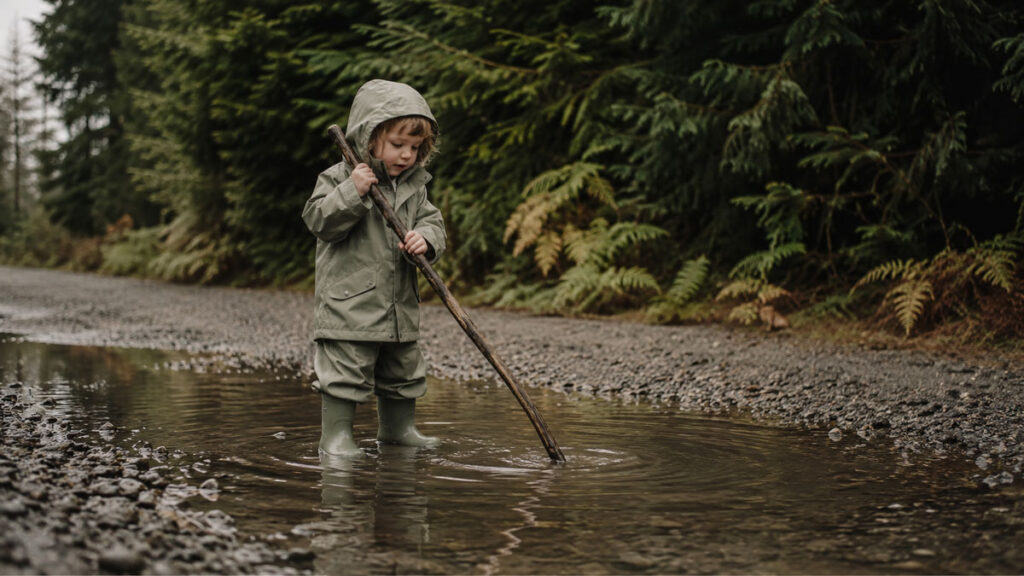
The workable principle is the familiar one: there is rarely bad weather, mostly inadequate clothing. Children in proper rain gear and boots are largely indifferent to rain, and puddles are among the best play materials that exist. What makes wet-weather outdoor play fail is almost always logistics rather than the child, specifically not enough spare dry clothing and nowhere sensible to change.
So the useful questions to a program are administrative rather than philosophical. What is your threshold for staying in. How much spare clothing do you hold, and what happens when a child is soaked through. Is there covered outdoor space so children can be outside during heavy rain. What is your policy on air quality during wildfire season, which is a genuine Squamish consideration in late summer.
A program that has thought this through will answer immediately and specifically. A program that has not will talk about the importance of nature in general terms.
What does good risk-taking look like?
The distinction worth holding is between risk and hazard.
A hazard is a danger the child cannot see and cannot assess: a broken fixing, a rusted bolt, a toxic plant, water deeper than it appears. Adults are responsible for removing hazards entirely, and a good program is rigorous about it.
A risk is a challenge the child can see and evaluate: a log to balance on, a slope to run down, a height to climb to. These have value precisely because the child does the assessing. Removing them removes the learning.
In practice this means an adult who stands near a climbing child without narrating a stream of warnings. Constant cautioning teaches a child to look to the adult for the safety judgement rather than making it themselves, which is exactly backwards. A useful question is neutral: what is your plan for getting down?
Ask a program directly how they think about risk. The answer separates programs that have considered it from programs that default to prohibition.
Does this change by age?
Considerably.
For infants and young toddlers, outdoor time is mostly sensory. Being on grass, feeling wind, watching branches move, touching different textures. It does not need to be structured and it should not be rushed. Our guide to infant care in Squamish covers this age band more fully.
For older toddlers, it is about movement and cause and effect. Carrying, dropping, pouring, climbing, running downhill. Gross motor work dominates.
For three to five year olds, outdoor play becomes collaborative and imaginative. Extended projects, dens, rules invented and renegotiated, and the beginnings of real investigation into what they find. This is also the age where nature knowledge starts to stick, and our guide to the preschool years in Squamish covers what else this band is for.
What can you do at home?
Less than you would think, in a good way. The most useful thing is unstructured time in an ordinary outdoor space with no plan attached.
Buy proper rain gear and boots, which removes the main obstacle. Go out in weather you would normally avoid. Allow the mud. Resist the urge to fill the time with an activity, since boredom outdoors resolves itself into invention faster than almost anywhere else. And slow your own pace, because a two year old walking down a path is not going anywhere and will stop for every interesting thing, which is the point.
How this works at Kinder Roots
Rooted in Nature is one of the four pillars our approach is built on, and our Redbridge campus in Squamish was designed with substantial outdoor space alongside the indoor rooms. The intent is that outdoor time is part of the ordinary rhythm of the day rather than a scheduled break from it. You can read about the campus on our campus page and about the thinking behind the pillars on our philosophy page.
Making outdoor play early childhood education takes seriously is mostly a question of commitment rather than facilities. Good rain gear, enough spare clothes, adults who tolerate mud, and a willingness to go out when the weather is unpromising will do more than any piece of equipment.
Now enrolling in Squamish
Outdoor space, built into the ordinary day
Rooted in Nature is one of the four pillars our approach is built on. Our Redbridge campus in Squamish was designed with substantial outdoor space alongside the indoor rooms, so time outside is part of the rhythm rather than a break from it.
Join the waitlistRedbridge campus, 1500 Scott Crescent, Squamish. Ages 10 months to 5 years.