



Starting child care is hard for almost every family, and the difficulty is not a sign that something has gone wrong. A child who protests at separation is a child with a secure attachment doing exactly what a securely attached child does. The goal of a good settling-in period is not to prevent that feeling. It is to help a child move through it and arrive somewhere steady on the other side.
Here is what actually helps, what to expect week by week, and what to do when it is harder than you expected.

Why is separation so hard, and is that normal?
Separation distress is developmentally appropriate and appears in most children somewhere between about eight months and three years, peaking for many around fourteen to eighteen months. It reflects two things a child has recently worked out: that you continue to exist when you leave, and that they cannot yet bring you back.
That is an uncomfortable piece of knowledge to hold with a two year old’s regulatory capacity. The protest is proportionate.
What makes it manageable is not the absence of the feeling but the presence of a reliable pattern. A child who learns that the goodbye happens the same way every time, that a specific adult will be there to receive them, and that the parent reliably returns, gradually stops treating the separation as an emergency. That learning takes repetition, and repetition takes weeks rather than days.
It is also worth saying plainly to parents: the fact that your child cries when you leave and is reportedly fine ten minutes later is not evidence that the crying was performance. Both things are real. The distress at the transition and the settling afterwards are both genuine.
What should the first two weeks of starting child care look like?
A gradual entry, if the program supports one, is worth arranging even when it is logistically inconvenient. This matters most for the youngest children, and our guide to infant care in Squamish covers that age group in more detail. The rough shape that works for most children:
Visits before the first day. One or two short visits with you present, where the child explores the room while you stay. The room becomes somewhere they have been rather than somewhere new.
Short first days. An hour or two, with you leaving briefly and returning. The child learns the most important fact first, which is that you come back.
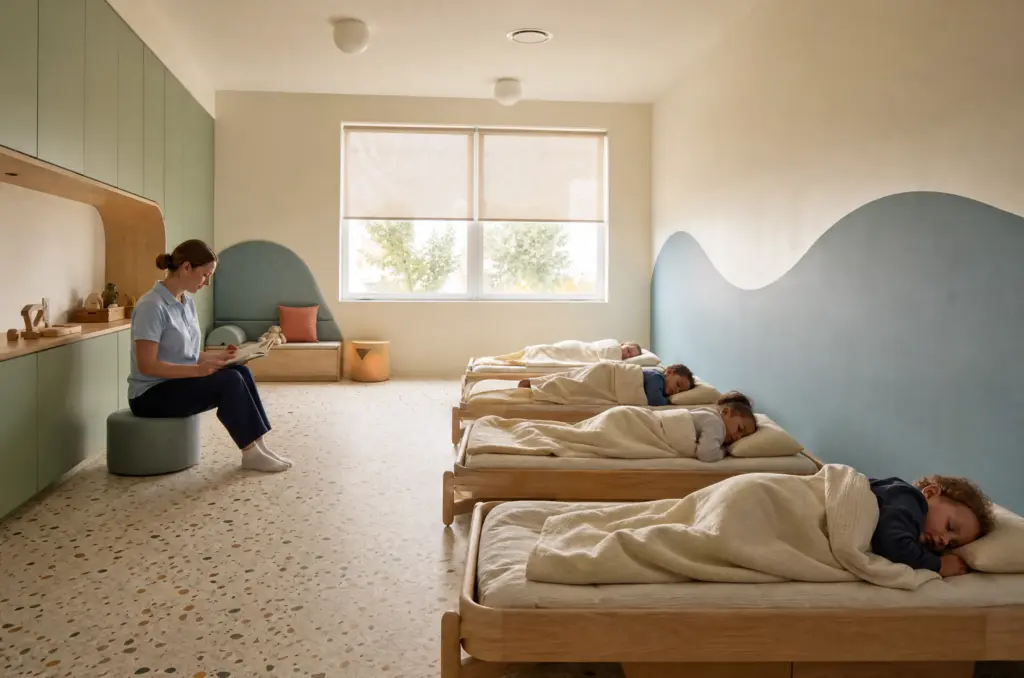
Building up across the first week. Longer stretches, including one meal or one sleep, since those are the moments a child most wants a familiar adult.
Full days from the second week. By this point the pattern is established, even if the goodbye is still hard.
If your work schedule makes this impossible, say so early and ask what the program can do. Many will compress it. What is worth avoiding, where you have any choice, is a first day that is also a full nine-hour day.
How should you handle the goodbye?
This is where most of the difference is made, and it comes down to three things.
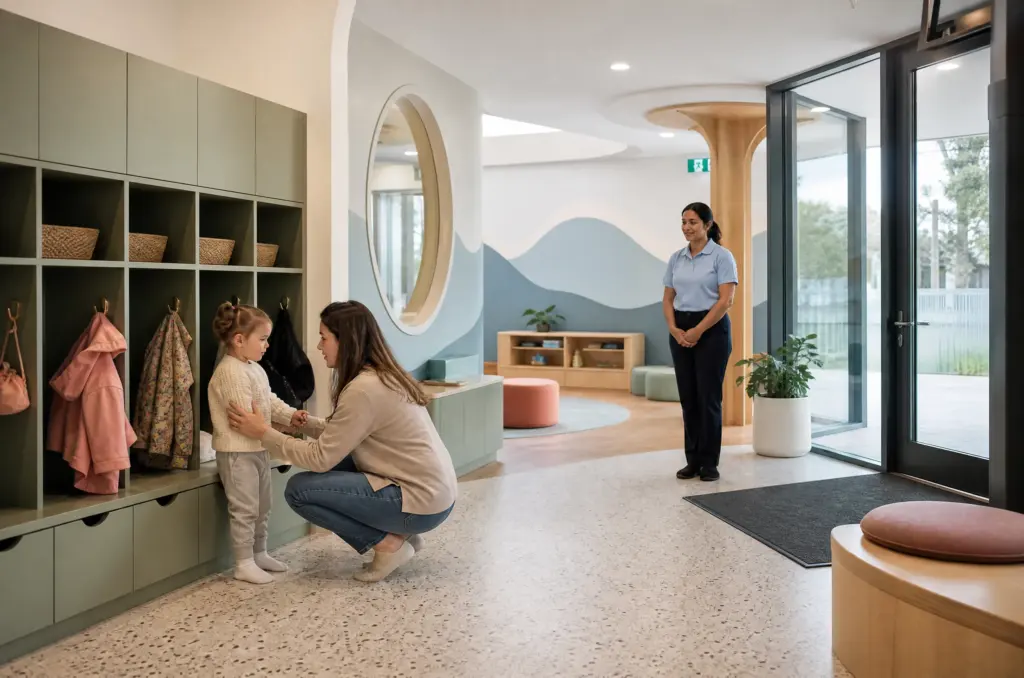
Be brief, warm, and consistent. Have a short goodbye that is the same every single time. A phrase, a hug, a wave at a particular window. The predictability is what does the work. Prolonging it in response to distress teaches a child that distress extends the goodbye, which makes tomorrow harder.
Never slip away. Leaving while a child is distracted avoids one bad moment and costs you the next month. A child who learns you might vanish without warning becomes a child who cannot relax and stop monitoring you. Always say goodbye, even when it is harder.
Do not transmit your own anxiety. Children read adult emotional states with remarkable accuracy, and a hesitant, apologetic, over-reassuring goodbye tells a child that this situation warrants concern. Steady and confident is a gift you give them, even when you are not feeling it. Cry in the car if you need to. Many parents do.
Tell your child the truth about when you are coming back, in terms they can use. After lunch, after outside time, after sleep. Time in hours means nothing at two. Time anchored to events means a great deal.

What can you do at home to help?
Several small things carry real weight.
Protect sleep above everything else. A tired child has almost no regulatory capacity, and the first weeks of care are already draining. Move bedtime earlier during the transition, not later, even though there is a pull to extend the evening to make up for lost time.
Simplify the rest of life. The fortnight you are starting child care is not the time to also begin toilet learning, move to a new bed, or take a trip. One large change at a time.
Send something familiar. A small comfort object that smells like home is genuinely regulating for many young children. Ask what the program allows.
Talk about it plainly and without excessive brightness. Over-selling it (“you are going to have SO much fun”) sets up a gap between the promise and the reality of a hard morning. Describing what will happen, calmly and specifically, works better.
Expect the evenings to be harder for a while, and expect sleep to be disrupted, which we cover in our guide to naps at child care. Many children hold themselves together all day and release it at home. Increased clinginess, night waking, more frequent meltdowns, and temporary regressions in things they had already mastered are all common and usually pass within a few weeks. It is not a sign the placement is wrong. It is a sign the child worked hard all day.
What if it is still hard after a month?
Most children settle within two to four weeks. Some take longer, particularly children who are naturally more cautious, and slower is not the same as failing.
What is worth a conversation with the program: a child who is not eating or sleeping at all after several weeks, a child who seems flat or withdrawn rather than protesting, distress that is escalating rather than gradually easing, or a child who was settled and has sharply regressed without an obvious cause at home.
Ask specific questions rather than general ones. How long did the distress last after I left, in minutes. Who does my child go to when they are upset. What does my child do in the first hour. Is there a particular part of the day that is consistently hard.
A program that can answer those questions in detail is watching your child closely. A program that only says they were fine is either not watching or not telling you, and either is worth pressing on.
What should a program be doing?
Settling in is a shared job, and the program’s half of it matters.
You should expect a named educator who takes particular responsibility for your child in the early weeks, so that there is one specific person the child is learning to trust rather than a rotating set. You should expect the same person to receive your child at arrival wherever possible. You should expect honest daily communication, including on hard days. And you should expect the goodbye to be handled with respect for the feeling rather than distraction away from it. Our guide to what to look for on a child care tour covers how to assess this before you enrol.
At Kinder Roots we treat arrival and departure as the two most significant moments of the day rather than as logistics around the edges of it. You can read more about how we approach the day on our curriculum page, and about the thinking behind it on our philosophy page.
The first weeks ask something real of both of you. Keep the goodbye short and the pattern the same, protect sleep, tell the truth about when you are coming back, and give it a few weeks before drawing conclusions. Most children arrive somewhere steady, and the settling holds once it comes.
Now enrolling in Squamish
A welcome, not a handover
We treat arrival and departure as the two most significant moments of the day rather than logistics around the edges of it. Gradual starts are supported, and the goodbye is handled with respect for the feeling.
Join the waitlistRedbridge campus, 1500 Scott Crescent, Squamish. Ages 10 months to 5 years.