
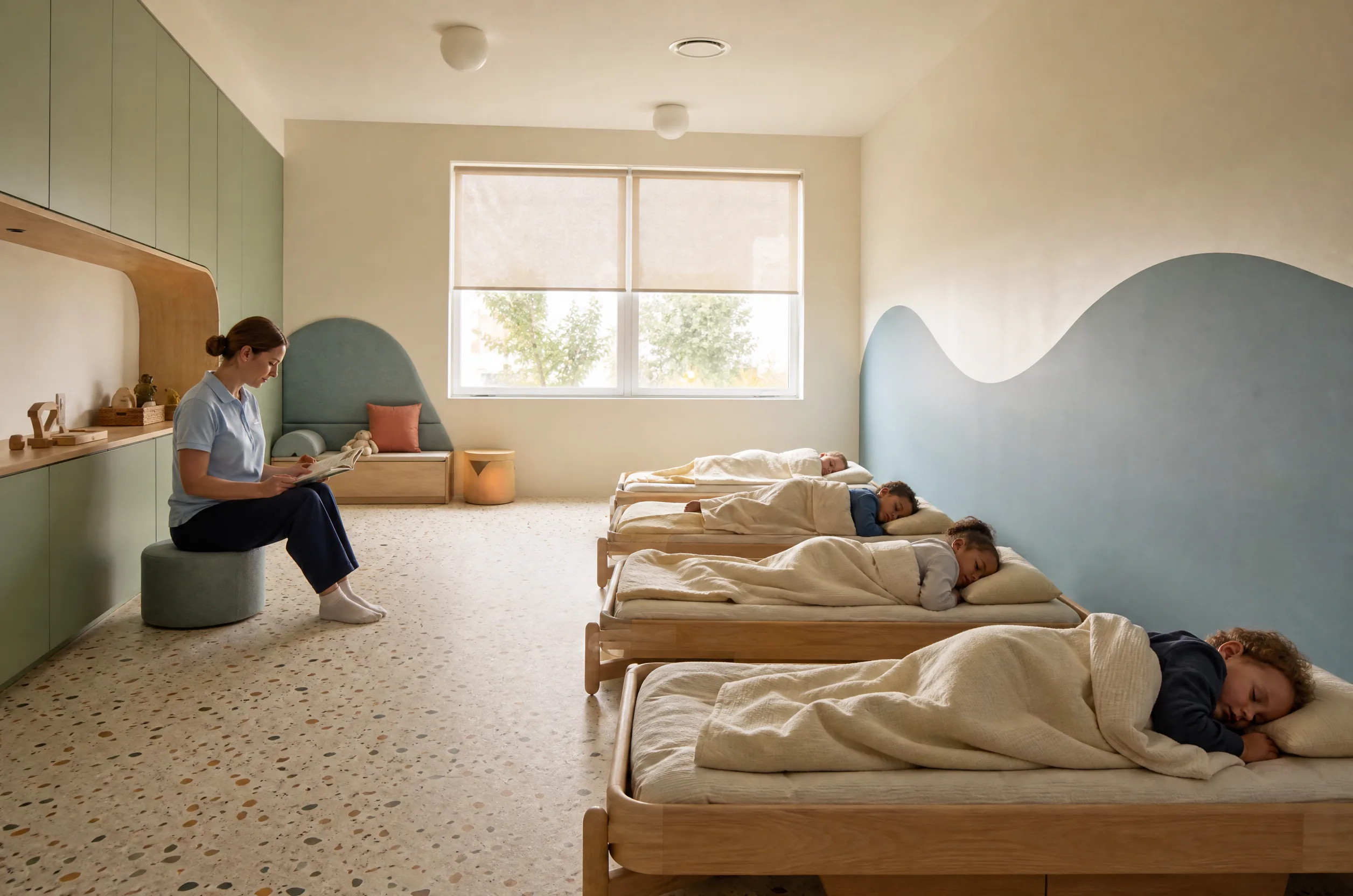



Naps at child care are one of the first things to go wrong when a child starts, and one of the least discussed before enrolment. A child who sleeps beautifully at home may refuse entirely in a new room, and a child who has dropped their nap at home may suddenly need one again. Both are normal, and both are worth planning for.
This guide covers what sleep looks like across the early years, how good programs handle it, what to ask before you enrol, and what to do when home and program are out of step.

How much sleep does a young child need?
Broad ranges, with wide individual variation inside them.
Infants under a year typically need a great deal of sleep spread across multiple naps, usually consolidating from three to two somewhere in the middle of the first year. Between roughly twelve and eighteen months most children move from two naps to one, and that transition is often bumpy for several weeks.
From about eighteen months to three years, one midday nap of one to two hours is typical, alongside a solid night. Between three and five, children gradually stop needing a daily nap, though the age at which this happens varies enormously. Some children are done at three. Others still need it at five, and both are within normal.
What matters more than hitting a number is the total across twenty four hours and how the child functions. A child who wakes rested, manages the afternoon without falling apart, and settles at night is getting enough, whatever the distribution looks like.
Why do naps at child care go differently?
Several reasons, and understanding them helps enormously in the first weeks.
The setting is unfamiliar. Different room, different smell, different light, different surface, other children nearby. Sleep requires a nervous system that feels safe, and safety takes time to establish in a new place.
There is more to pay attention to. A stimulating morning with other children is harder to switch off from than a quiet morning at home. Some children are too wired to settle, particularly early on.
The schedule is fixed. Programs nap on a group rhythm. A child whose natural window sits half an hour either side of that will struggle at first, then usually adjust.
Other children are a distraction and a comfort. Both, often in the same week. Many children who initially cannot settle later sleep better in a room of sleeping peers than alone.
The usual pattern is that sleep is disrupted for the first two to four weeks and then settles. If your child is not napping at all in the early period, that is common and not a sign the placement is wrong. Our guide to starting child care covers the wider settling-in picture.
What should a good program do?
Six things worth asking about directly.
Follow safe sleep practice. For infants this is non-negotiable and licensed programs are required to comply: on the back, on a firm flat surface, no loose bedding or soft items in the cot.
Provide a genuinely calm environment. Dimmed rather than fully dark, quiet but not silent, consistent from day to day. A predictable pre-nap routine matters more than the room itself.
Allow individual rhythms where possible. Particularly for infants, who should not be forced onto a group schedule before they are ready. Ask how much flexibility exists.
Never use sleep as leverage. No child should be made to stay on a cot as a consequence, and no child should be woken punitively. Sleep should never be attached to behaviour.
Have a plan for non-sleepers. Older children who no longer nap still need a quiet period, and it should be genuinely restful rather than an hour of enforced stillness. Ask what a non-sleeping four year old actually does.
Communicate honestly. You should know how long your child slept and roughly how settling went, including on the bad days.

What if home and the program are out of step?
This is the most common practical friction, and it usually resolves.
Your child naps at the program but fights bedtime. Usually the nap is running too late or too long. Ask whether it can be capped or shifted earlier. Most programs will accommodate a reasonable request.
Your child will not nap at the program but is exhausted by pickup. Expect this in the early weeks. Move bedtime earlier while it resolves, and resist adding a late car nap that pushes bedtime back.
Your child has dropped their nap at home but sleeps at the program. Extremely common, and generally means the day is more demanding than a day at home. Let it happen and adjust the evening.
You want them woken at a set time. Reasonable to ask, and most programs will do it. Understand that waking a child mid-cycle produces a rough afternoon, so it is a trade.
The general principle: give any change two weeks before concluding it is not working. Sleep is slow to shift and most disruption is transitional.
When should you raise a concern?
Most sleep variation is ordinary. A few patterns are worth a conversation with your program or your care provider.
A child who is not sleeping at all after several weeks and is visibly exhausted. Sleep that was established and has sharply regressed with no obvious cause at home. A child who seems flat or withdrawn rather than simply tired. Or a total daily sleep amount that has dropped well below the range for their age and stayed there.
None of these means something is wrong. All are worth raising, and a program watching closely will usually have noticed first. Our guide to developmental screening in early childhood covers how that observation should work.
What to ask before you enrol
Put these on the list for any visit. What time is rest period and how long does it last. What happens to a child who does not sleep. Can my child’s individual rhythm be accommodated, particularly for infants. What is the room like during rest, and can I see it. How do you settle a child who is struggling. What will you tell me at pickup about how sleep went. Is sleep ever used as a consequence.
Our guide to what to look for on a child care tour covers the wider set of questions worth asking, and our guide to toddler care in Squamish covers the age band where nap transitions are most disruptive.
How we think about rest
Rest is part of the rhythm of the day rather than an interruption to it. A child who has slept enough can be curious, tolerate frustration, and manage the social demands of a room full of other people. A child who has not can do none of those things well, and no curriculum compensates. You can read about how the day is structured on our curriculum page.
Naps at child care take a few weeks to settle, and almost always do. Ask the practical questions before you enrol, expect disruption at the start, protect the evening while things adjust, and give any change a fortnight before drawing conclusions.
Now enrolling in Squamish
Rest as part of the rhythm
A child who has slept enough can be curious, tolerate frustration, and manage a room full of other people. A child who has not can do none of those things well, and no curriculum makes up for it.
Redbridge campus, 1500 Scott Crescent, Squamish. Ages 10 months to 5 years.
Reviewed by the Kinder Roots Education Team