


A child care meal program is one of the least examined parts of a program and one of the most revealing. Children in full-day care eat two or three times a day, five days a week, for years. That is a substantial share of everything they consume in early childhood, and the way a program handles it tells you a great deal about how it thinks about children generally.
This guide covers what to ask, what good practice looks like, and why the way food is handled matters as much as what is served.
What should a child care meal program actually provide?
The first question is simply whether food is included at all, because practice varies widely. Some programs provide everything, some provide snacks only, and some require families to send all food. Each is workable, but the cost comparison between programs is meaningless until you know which model you are looking at.
Where meals are provided, ask for a sample menu covering several weeks rather than one day. A single day can be arranged. A month shows you the pattern.
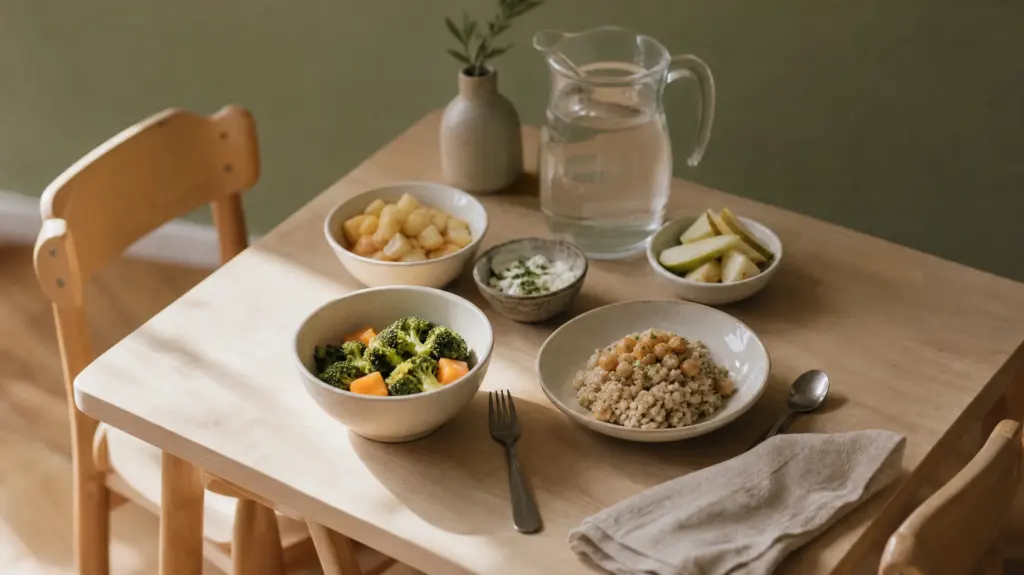
What you are looking for in that menu is variety across the week, vegetables appearing as a genuine component rather than a token side, whole foods rather than a reliance on processed convenience items, and some rotation rather than the same five meals repeating indefinitely. Also worth noting: does the menu look like food an adult would eat, or does it look like a separate category of beige children’s food? The second is a signal worth paying attention to.
How is food handled, and why does that matter more than the menu?
This is the part most parents never ask about, and it has a longer-lasting effect than nutrition alone.
The way adults behave around food in early childhood shapes a child’s relationship with eating for years. A few principles distinguish programs that have thought about this from programs that have not.
Children decide how much. The adult decides what is offered and when. The child decides whether and how much to eat from what is there. This division is well established and it prevents a great deal of conflict.
No pressure, no bargaining, no rewards. Children should not be pressed to finish, and food should never be used as a reward or withheld as a consequence. Attaching food to behaviour reliably damages the relationship with eating.
No commentary on quantity. Praise for eating a lot and concern about eating little both teach a child to eat for adult approval rather than for hunger. Neutral is the aim.
Repeated exposure without insistence. A new food may need to appear many times before a child accepts it. Offering it calmly and repeatedly, without requiring a taste, works. Insisting does not.
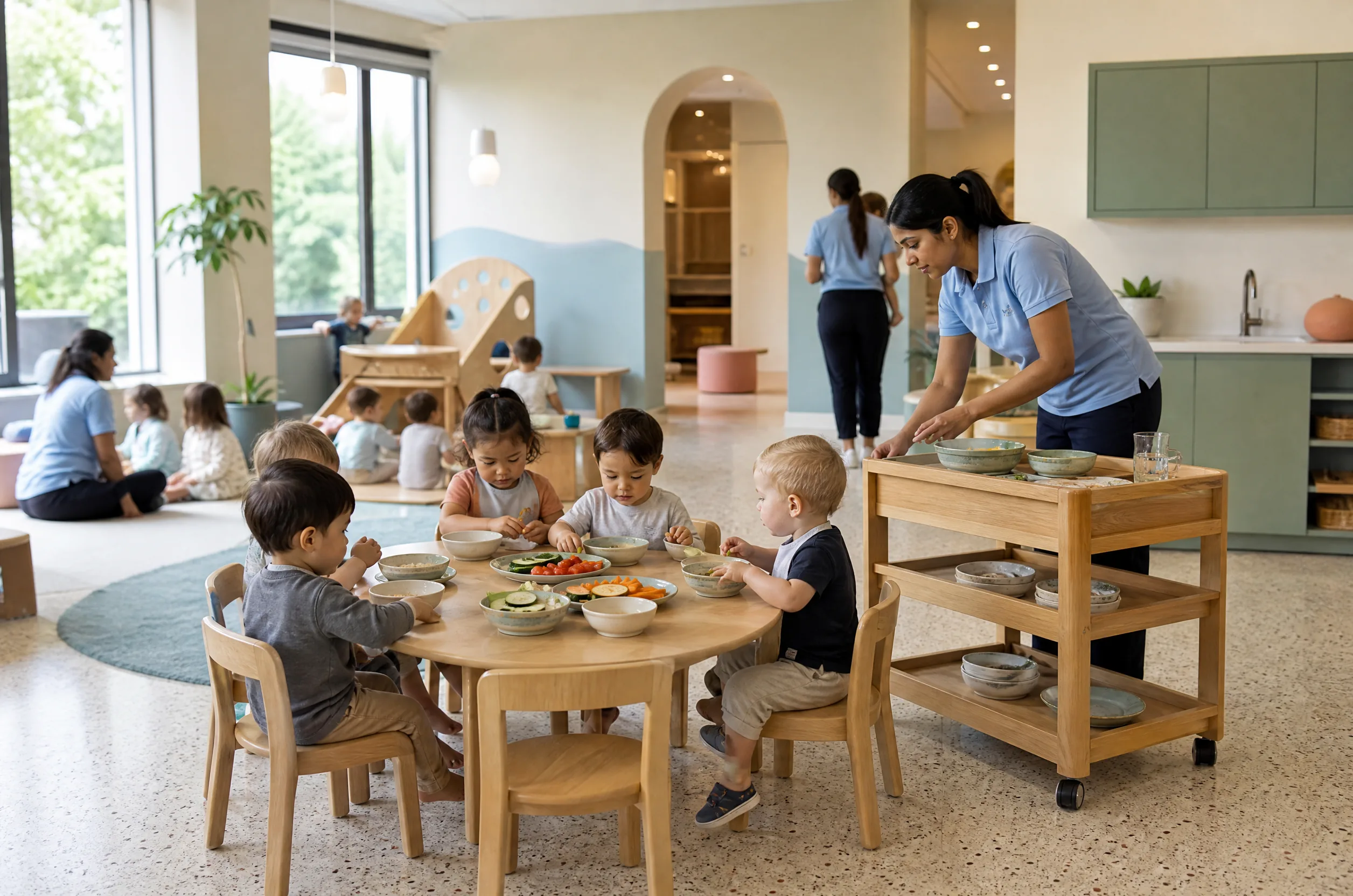
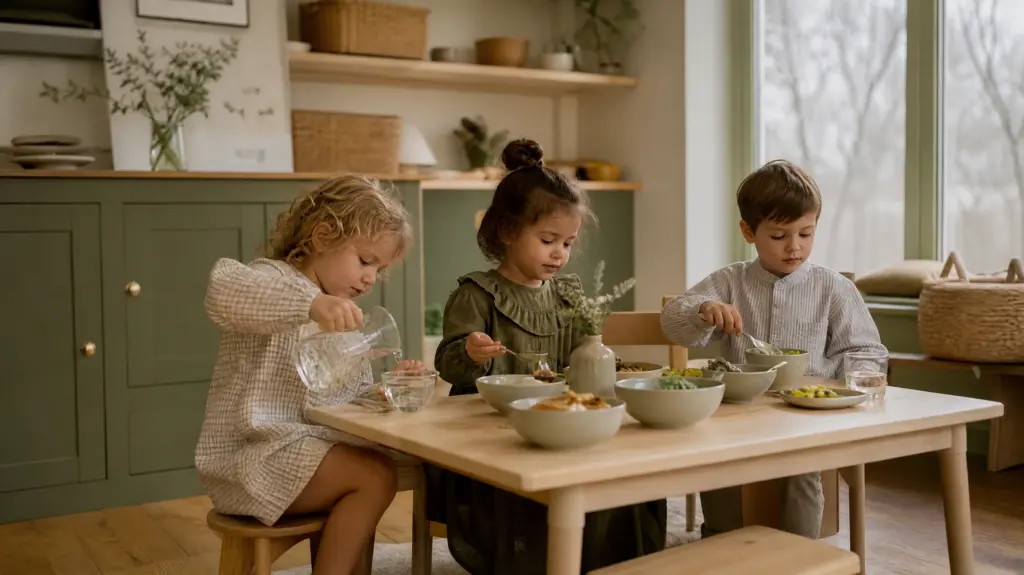
Adults sit and eat with children where possible. Family-style meals with an adult present model everything you want: conversation, trying things, serving oneself, waiting.
Ask directly what happens when a child refuses a meal entirely. A calm answer that involves offering, accepting the refusal, and moving on tells you the program has this right.
What about toddler appetite?
Worth its own note, because it worries parents more than almost anything.
Appetite between roughly one and three is erratic by design. Growth slows considerably after the first year, and intake drops to match. A week of eating almost nothing followed by a week of eating everything is the normal pattern, not a problem to solve.
What matters is the trend across weeks rather than any single day, and whether the child has energy and is growing along their own curve. A program that reports a day of poor eating as information rather than as an alarm is reading it correctly.
Our guide to toddler care in Squamish covers more of what is normal in this age band.
How should allergies and restrictions be handled?
This is a safety question and the answers should be precise rather than reassuring.
Ask how allergies are recorded and how that information reaches whoever is actually serving food, including relief staff who do not know the children. Ask whether the facility is nut-free or otherwise restricted, and how that is enforced with food brought from home. Ask where emergency medication is stored, who is trained to administer it, and how quickly it can be reached from any room. Ask about cross-contamination practice in the kitchen.
For dietary requirements that are not allergies, whether religious, cultural, or by family preference, ask how substitutions work and whether the child eats something visibly similar to what everyone else is having. A child receiving a conspicuously different plate every day notices, and a program that has thought about it will have addressed that.
A program that answers these crisply has systems. A program that says it will be fine does not.
What questions should you ask on a visit?
A short list that covers most of it.
Are meals and snacks included in the fee, or charged separately. Can I see four weeks of menus. Who prepares the food, and is it made on site. What happens when a child does not want to eat. Are children ever pressured, praised, or bargained with about food. Do adults sit and eat with the children. How do children serve themselves, and from what age. How are allergies recorded and communicated to relief staff. What happens if my child is still hungry.
Our guide to what to look for on a child care tour covers the wider set of things to notice while you are there.
Why mealtimes are more than eating
In a well-run room, a meal is one of the richest parts of the day.
Serving yourself from a shared bowl is fine motor practice and a genuine act of independence. Pouring from a small jug takes real coordination and produces real pride. Waiting while others are served is early self-regulation. Conversation across a table is language development at its most natural. Clearing your own plate is practical-life work that builds competence.
None of that happens when food arrives pre-portioned on a tray and the goal is to get everyone through it quickly. The difference between those two versions of lunch is not nutritional, and over three years it is substantial.
This connects to something broader. The pace of a meal, the noise level, and whether an adult is sitting calmly nearby all affect a child’s nervous system in the same way the rest of the environment does. Our guide to emotional regulation in toddlers covers why that steadiness matters so much at this age.
How we approach it
Our Redbridge campus includes a full daily meal program prepared on site, and mealtimes are treated as part of the curriculum rather than a break from it. Children serve themselves where they are able, use real crockery and cutlery rather than moulded plastic, and eat with adults present at the table. You can read more about the campus on our campus page and about the daily rhythm on our curriculum page.
When you are comparing programs, ask for the menus, then ask what happens when a child refuses to eat. The first tells you about nutrition. The second tells you what the program believes about children, and that is the more useful answer.
Now enrolling in Squamish
Meals prepared on site, eaten together
Children serve themselves where they are able, use real crockery rather than moulded plastic, and eat with adults at the table. Mealtimes are part of the curriculum, not a break from it.
Redbridge campus, 1500 Scott Crescent, Squamish. Ages 10 months to 5 years.
Reviewed by the Kinder Roots Education Team