



The single most useful thing an early learning program can do for a child, beyond the daily work of caring for them well, is notice things early. The years between birth and five are the period in which the brain is most responsive to support, which means the same intervention delivered at three does considerably more than it does at six.
This is what developmental screening is for. Most parents have never been told this plainly, and most have no idea what structured developmental screening is or why they should ask a program about it. This article explains what it is, what it is not, and what questions are worth putting to any program you are considering.
Why does early observation matter so much?
Brain development in the first five years is not evenly distributed across childhood. It is front-loaded. The neural pathways underlying language, motor control, and social understanding are laid down at extraordinary speed in this window, and they are more responsive to change during it than they will be afterwards.
The practical consequence is that timing matters more than intensity. A modest amount of well-targeted support at two or three can do more than a much larger effort at seven, because at two or three you are shaping a system that is still forming rather than trying to redirect one that has settled.
The difficulty is that the differences worth noticing at this age are often subtle. A child who is a little slower to combine words, or who finds transitions unusually hard, or who avoids certain textures, is well inside the range of ordinary variation. Our guide to the preschool years covers what typically develops between three and five. Most such children need nothing at all. A few benefit enormously from a small amount of early help. Telling those groups apart by eye, informally, is genuinely difficult, and it is why structured observation exists.
What is developmental screening?
Screening is a structured way of checking a child’s development against typical ranges across several domains, usually communication, gross motor, fine motor, problem solving, and personal-social development.
Three things it is important to be clear about.
Screening is not diagnosis. A screening tool cannot tell you that a child has a particular condition. It can only indicate whether a closer look by a qualified professional would be worthwhile. Anyone who tells you otherwise is misusing it.
It is a snapshot, not a verdict. A child who is tired, unwell, shy with the person observing, or simply having a bad week can screen differently than they would a fortnight later. This is why repeated screening over time is far more informative than a single result.
Most results are unremarkable, and that is useful too. The majority of children screen within typical ranges. A clear result is not a wasted exercise. It is a baseline, and a baseline is what makes later change visible.
The tool most widely used across North America is the Ages and Stages Questionnaires, usually shortened to ASQ. It is completed with input from the people who know the child best, which in practice means parents and educators together, and it is designed to be used repeatedly as a child grows.
Why do programs sometimes avoid this?
It is worth being honest about the reasons, because they explain why you should ask rather than assume.
Raising a developmental question with a parent is an uncomfortable conversation. It risks worrying a family, it risks the family becoming defensive, and in a competitive market it risks a family leaving. A program that says nothing avoids all of that discomfort, and nobody notices the cost, because the cost is invisible and arrives years later.
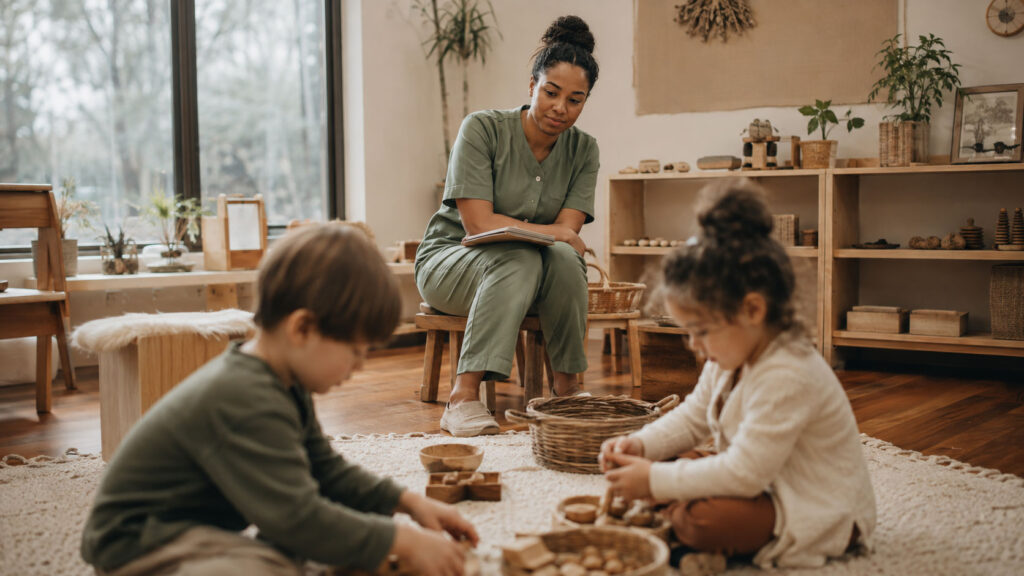
There is also a genuine skill gap. Observing well requires training, time, and a system for recording what is seen. An educator managing a full room with no structure for observation is not in a position to notice patterns even when they are there.
So when you ask a program about this, you are testing two things at once: whether they have the structure to notice, and whether they have the willingness to say something.

What should you ask a program?
Six questions that get past reassurance and into practice.
Do you use a structured developmental screening tool, and which one? A specific name is a good sign. “We keep a close eye on the children” is not an answer to this question.
How often, and starting when? A baseline early in a child’s time with the program, then repeated at intervals, is what makes patterns visible. One screening at entry and nothing afterwards tells you very little.
Am I involved in completing it? You see your child in contexts the program never does. Screening that draws on both settings is substantially more accurate than screening from one.
What happens if something comes up? Listen for whether there is an actual process. Who tells you, how soon, in what setting, and what is offered next.
Who do you refer on to? Ask whether they have working relationships with speech-language pathologists, occupational therapists, or behavioural specialists. Knowing that a child might benefit from support is only half the job. Knowing who to call is the other half, and in a smaller community those relationships take years to build.
Can I see what you record about my child? Observation notes should not be a private file. A program that shares its documentation is a program treating you as a partner.
What if something is flagged?
First, the reassuring part. A flag means one thing: a closer look is worthwhile. It does not mean a diagnosis is coming, and a substantial proportion of flagged children turn out to need nothing beyond time.
What usually happens next is a conversation with the program about what specifically they have observed and in what situations, then, if it seems warranted, a referral for a proper assessment by a qualified professional. In British Columbia your family doctor or a public health nurse is often the route in, and locally the Sea to Sky Child Care Resource and Referral coordinator can point families toward the relevant services.
Two things are worth holding onto during that period. Waiting lists for assessment can be long, so starting the process early matters more than being certain it is necessary. And a child does not change when a label is applied. They are exactly who they were the day before, and any support that follows is about giving them more of what they already respond to.
It is also entirely reasonable to feel unsettled by that conversation. Most parents do, much as they do in the first few weeks of child care. That feeling is not a reason to avoid the conversation, and a good program will give you time with it rather than rushing to resolve your discomfort.
What if you have concerns the program has not raised?
Raise them. You are not being difficult, and parental observation is one of the more reliable early signals there is.
Be specific rather than general. Rather than saying you are worried about speech, describe what you actually notice: how many words, whether unfamiliar adults understand them, whether your child seems frustrated at not being understood. Specific observations are far easier for a program to act on, and easier to compare against what they see.
If a program dismisses a specific, repeated concern without engaging with it, that is meaningful information about the program.
How we approach this
Kinder Roots integrates the Ages and Stages Questionnaires directly into our care model. Each child receives a baseline assessment and ongoing re-screenings, which lets us recognise developmental patterns as they emerge rather than after they have become entrenched. We work alongside specialists including speech-language pathologists, occupational therapists, and behavioural specialists, so that families who need a next step have somewhere to go rather than a worry and no map.
You can read more about how this sits inside our wider approach on our why choose us page, and about the thinking behind it on our philosophy page.
Careful observation is quiet work, and most of the time it produces nothing more dramatic than a clear record of a child developing well. That record is worth having. And on the occasions when it does surface something, the years in which you find out are exactly the years in which finding out helps most.
Now enrolling in Squamish
Careful observation, built into the model
We integrate the Ages and Stages Questionnaires into our care model, with a baseline and ongoing re-screenings, and work alongside speech-language pathologists, occupational therapists, and behavioural specialists.
Join the waitlistRedbridge campus, 1500 Scott Crescent, Squamish. Ages 10 months to 5 years.