


Sea to Sky child care operates as one connected market rather than three separate towns. Families commute between Squamish, Whistler, Pemberton, and North Vancouver, waitlists overlap, and a space that opens in one community routinely gets taken by a family living in another. Understanding that changes how you search.
This guide covers how the corridor works as a whole, what differs between communities, and how to search across it rather than within a single town.

Why treat Sea to Sky child care as one market?
Because families already do, whether or not they intended to.
The corridor is a commuting region. A substantial number of people living in Squamish work in Whistler or in the North Shore, and the reverse is true as well. That means child care decisions are made against a commute rather than a postcode, and a program twenty minutes in the direction you already drive is often more practical than one five minutes away in the wrong direction.
It also means waitlists are not local in the way people assume. A family in Brackendale may hold places on lists in Squamish, Whistler, and North Vancouver simultaneously. Providers know this, which is part of why nobody will give you a meaningful position number.
The practical consequence is that limiting your search to one town in a supply-constrained market makes an already difficult search harder for no reason.
What differs between the communities?
Enough to shape where you look.
Squamish. The fastest-growing young family population in the corridor and correspondingly the most pressure on spaces. The District has documented available space as severely limited, particularly under three. It also has the most programs, which means the most opportunities as well as the most competition.
Whistler. A distinctive labour market shaped by seasonal and hospitality work, which means demand for non-standard hours and a workforce that turns over. Fewer spaces overall relative to the working population.
Pemberton and the north. Smaller, with fewer licensed programs and more reliance on family care and unlicensed arrangements. Waits can be shorter simply because the population is smaller, but options are thin.
North Vancouver and the North Shore. A much larger market at the southern end, with more programs. It only makes sense if you already commute that way, but for families who do it materially widens the search.
Squamish neighbourhoods. Within town, Valleycliffe, Brackendale, Garibaldi Highlands, Downtown, and the newer developments each sit differently relative to the highway. In a place where the commute is the constraint, which side of town a program is on genuinely matters.
How should you search across the corridor?
Five things that make a difference.
Map by commute, not distance. Work out what is actually on your route at the time you travel. Highway 99 conditions vary considerably by hour and season, and a program that is convenient at nine is not necessarily convenient at half past seven.
Join lists in more than one community. This is standard practice and no provider will think less of you for it. The system assumes it.
Use the referral service. The Sea to Sky Child Care Resource and Referral program coordinates across the whole corridor on behalf of the Ministry of Children and Family Development and holds a view no single provider has. It is the single most underused resource in the region.
Consider a program near work rather than home. It shortens your child’s separation from you across the commute, and it means you are close if something happens during the day. The trade is that a sick day or a car problem becomes more complicated.
Watch for new capacity. Established waitlists move only when children leave. A new campus adds many spaces at once, which is a different and much faster kind of opportunity. Our guide to child care waitlists in Squamish covers the timing in detail.

What is the same everywhere in the corridor?
Several things worth knowing so you can compare programs on equal terms.
Licensing is consistent. Every licensed program from Lions Bay to Pemberton is regulated by Vancouver Coastal Health under the same provincial standards, with the same ratios, qualification requirements, and inspection regime. Our guide to licensed child care in BC covers what that means, and our guide to child care ratios in BC explains the staffing rules that drive availability.
Subsidies are provincial. The fee reduction initiative and the Affordable Child Care Benefit work identically wherever you are, so a program in Whistler and a program in Squamish are subject to the same funding structure. See our guide to BC child care subsidies.
The under-three shortage is universal. Every community in the corridor has its longest waits at the youngest ages, for the same staffing reasons. Our guide to infant care in Squamish covers that band.
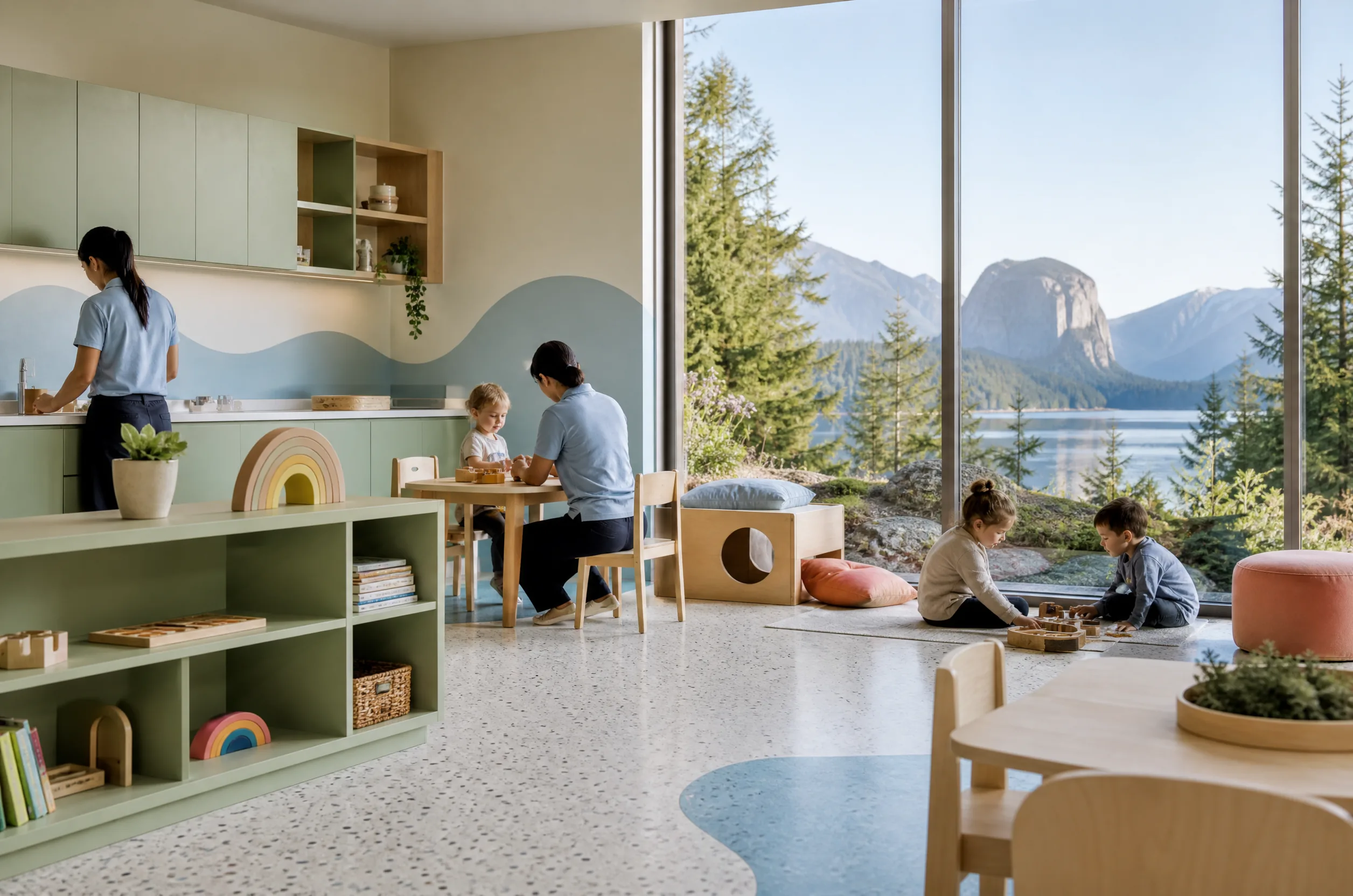
And the landscape is a shared asset. Programs across the corridor have unusually good access to forest, river, and mountain, and the ones that use it well are doing something genuinely valuable. Our guide to outdoor play in early childhood covers why that matters.
What about the commute itself?
Worth thinking about honestly, because it is a daily cost paid by your child as well as you.
A long commute extends the child’s day at both ends. A nine-hour program day plus an hour of driving is a ten-hour day for a three year old, and tiredness compounds through the week. If the commute is unavoidable, protect the evening: earlier bedtime, simpler evenings, and low expectations of what a tired child can manage after five o’clock.
Consider also who does pickup. Highway 99 has weather closures and accidents with real frequency, and a program that closes at six is unforgiving about it. Having a second person who can collect is not a luxury in this corridor.
Where Kinder Roots sits
Our Redbridge campus is at 1500 Scott Crescent in Squamish, opening in Fall 2026 with 117 spaces across three age bands from ten months to five years. Its position makes it workable for families in Squamish itself and for those commuting in either direction along the corridor. Because it is a new campus, the spaces open together rather than one at a time as children age out. You can find directions and details on our campus page and the age bands on our programs page.
Searching for Sea to Sky child care works best when you treat the corridor as one market, join lists in more than one community, map your options against the commute you actually make, and use the referral service that already sees the whole region. The search is hard here, and it is considerably harder when you look at only one town.
Now enrolling in Squamish
117 new spaces in the corridor
Our Redbridge campus sits in Squamish, workable for families here and for those commuting in either direction along Highway 99. New capacity rather than turnover, which is the faster kind of opportunity.
Redbridge campus, 1500 Scott Crescent, Squamish. Ages 10 months to 5 years.
Reviewed by the Kinder Roots Education Team