


The question parents ask about screen time in early childhood is usually how much, and the Canadian guidance answers it in one line: none under two, and under an hour a day from two to five. The more useful question is why those numbers exist, because the reasoning explains which screen use is actually a problem and which is not. A video call with a grandparent and an hour of autoplay are not the same thing wearing different labels.
Here is what the guidance says, what sits behind it, and how to think about it without running a stopwatch.
What does the Canadian guidance on screen time in early childhood say?
The Canadian Paediatric Society and the Canadian 24-Hour Movement Guidelines for the Early Years are aligned on this.
Under two years. Screen use is not recommended. The stated reason is direct: children this age do not learn from it. The exception named in the guidance is video chatting with caring adults, such as extended family, because that is a real interaction with a responsive person rather than consumption.
Two to five years. Limit routine or sedentary screen use to about an hour a day or less, with less being better.
You will see a two-hour figure on some Canadian health pages. The one-hour figure is the current position in the Canadian Paediatric Society’s own materials, so treat that as the number.
The guidance also makes a point that gets lost in the headline: screens should not displace sleep, physical activity, or interaction with adults. The limit exists to protect those three things, which is the actual mechanism and the reason a rigid minute count misses the point.
Why is under two treated differently?
Because of what the first two years are for, and because of a well-documented finding about how young children learn.
Children under about two and a half learn considerably less from a screen than from the same content delivered by a person in the room. They can learn a word, an action, or a solution from a live adult and fail to learn the same thing from a recording of that adult. The likely reason is that learning at this age runs on contingent interaction, the back and forth where an adult responds to what this particular child just did. A screen cannot do that. A video call, which can, is why it sits outside the recommendation.
There is a second, more ordinary cost. The kind of development happening before two is built almost entirely from interaction with people and physical handling of real objects. Every hour on a screen is an hour not spent on either, and at that age there are not many spare hours.
This is also where the nervous system argument sits. A young child’s capacity to regulate is still being built, and it is built through pace, through predictability, and through the emotional state of the adults around them. Fast-cut, high-stimulation content runs in the opposite direction from all three. The effect most parents notice, that a child is harder to settle after a screen, is not imagination.
Is all screen time the same?
No, and the guidance is explicit that quality and context matter alongside quantity. Four distinctions do most of the work.
Interactive or passive. A video call with a grandparent is an interaction. Autoplay video is consumption. These belong in different categories.
With an adult or alone. A show watched alongside a parent who is talking about it, naming things, and answering questions is a shared language activity. The same show watched alone is not. Co-viewing changes what the time is.
Pace and content. Slow, narrative, repetitive content with a stable cast is easier for a young child to follow and process. Rapid cuts, constant novelty, and loud reward loops are harder, and they are harder to come down from.
What it replaced. Twenty minutes while a parent cooks dinner, in a day that also had outdoor play, books, and conversation, is not the issue the guidance is aimed at. Three hours that displaced all of those is.
What about screens in a program?
Reasonable to ask on a tour, and the answer tells you something about how the program thinks.
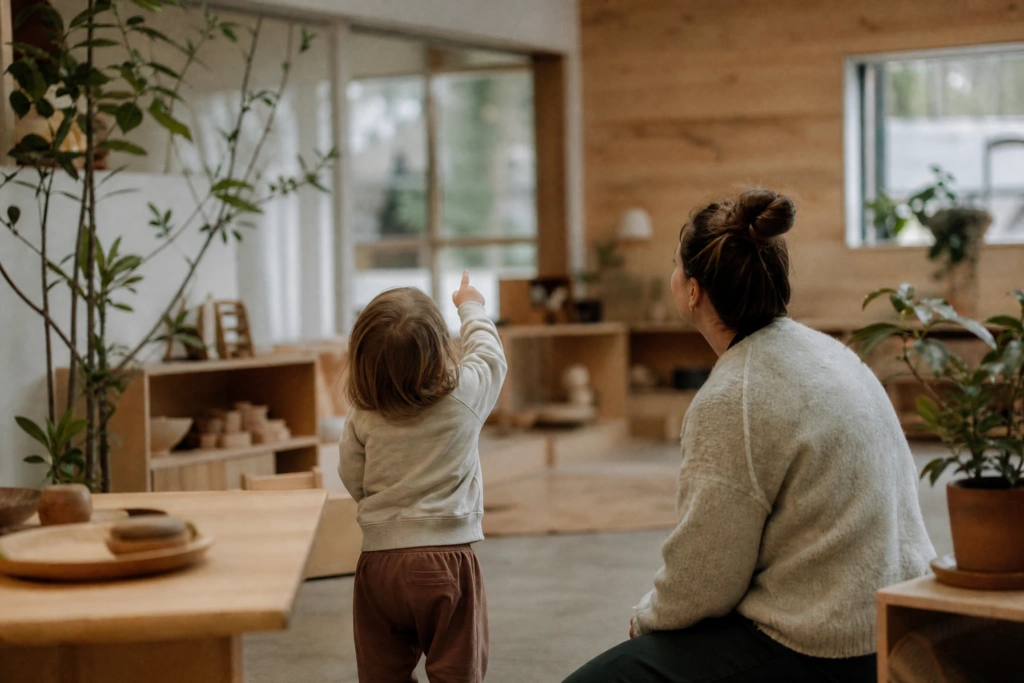
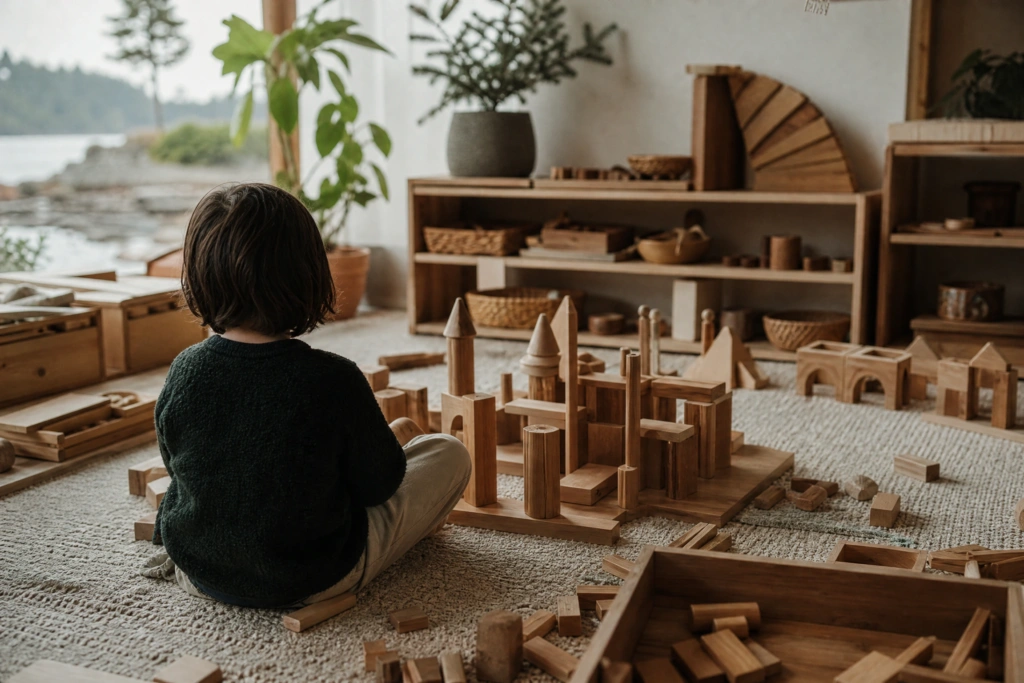
There is no developmental case for screens in an early years room. A room with a well-designed environment, open-ended materials, and educators who are present does not need one, and the time has better uses. Some programs use a screen for a specific, bounded purpose, looking something up that a child asked about, or watching a short clip of a bird they found outside. That is a tool being used to extend a child’s inquiry, which is a different activity from a video being put on.
The question worth asking: are screens used in the rooms, and if so, for what. An answer that names a specific purpose is fine. An answer involving quiet time or transitions suggests screens are doing a job the environment and the staffing should be doing.
How do you make the limit workable?
The families who find this manageable tend to have made it a structure rather than a negotiation.
Decide when screens happen rather than how long. A fixed slot, after dinner, or Saturday morning, removes the question from the rest of the week. A daily allowance invites a daily discussion about it.
Choose finite content. A single episode ends. A feed does not, and the ending is the hardest part for a child whose sense of time is still forming. Turn off autoplay.
Warn before the end. A child pulled out of absorption without notice will protest, the same as a child pulled out of a block structure. Say what is coming, then follow through.
Keep screens out of bedrooms and away from the hour before sleep, which is the recommendation with the clearest evidence behind it.
Watch with them when you can. It converts the time into something useful and it means you know what they are seeing.
And accept that some weeks will not work. A sick child, a long flight, a week where one parent is away. The guidance describes a pattern across a childhood, not a rule that can be broken.
What is the thing actually worth protecting?
If the hour feels arbitrary, work backwards from what the guidance is trying to preserve.
Sleep, because almost everything else depends on it. Physical movement, because a young child’s thinking is built through their body. Unstructured play, because that is where attention, imagination, and problem-solving get built. And conversation with adults, because vocabulary at five is one of the better predictors of later reading, and it comes almost entirely from talk.
A day with those four intact has room for twenty minutes of something on a screen. A day without them is not improved by removing the screen alone.
Our piece on why outdoor play does the real work covers the most reliable substitute, and our guide to co-regulation in toddlers covers the settling that screens are often reached for.
The more useful question
Counting minutes is the least informative way to think about this. The better question is what a child’s day is made of: whether they moved, whether they were outside, whether they played without direction, whether they slept enough, and whether somebody talked with them properly. Build the day around those and the screen question mostly answers itself. The guidance is a floor under the days when it does not.
Now enrolling in Squamish
A room worth paying attention to instead
There are no screens in our rooms. Design Forward is one of the four pillars the Kinder Approach is built on, which means the environment is doing the work a screen would otherwise be asked to do.
Join the waitlistRedbridge campus, 1500 Scott Crescent, Squamish. Ages 10 months to 5 years.
Reviewed by the Kinder Roots Education Team